

Questions shape our conversations and help us learn about others. Yet when we ask about categories, many English speakers stumble over a small but crucial detail: choosing between ‘what kind of’ and ‘what kinds of’. This tiny pair can change how clear a question sounds or what response you get. Have you ever paused mid-sentence, wondering whether to say ‘what kind of books’ or ‘what kinds of books’?
In short, picking ‘what kind of’ or ‘what kinds of’ comes down to whether you want one type or multiple types. Getting this right can make your questions sharper and help avoid awkward replies. Let’s explore how mastering this small detail can boost clarity and confidence in your daily conversations.
Basic usage rules
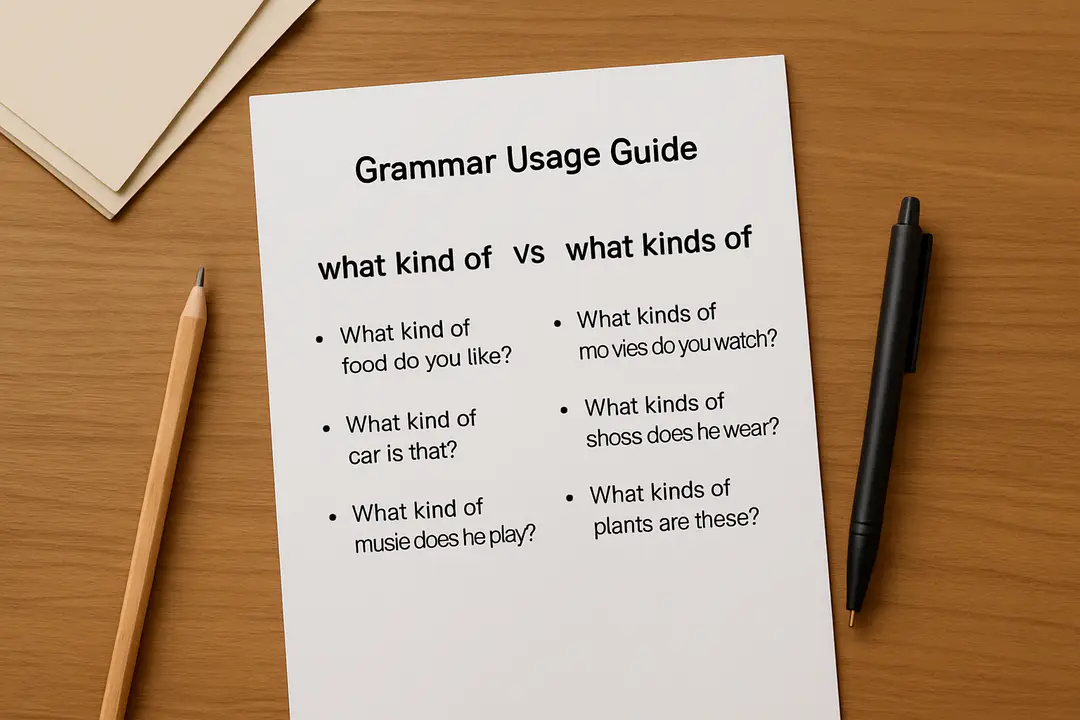
At its core, “what kind of” is used when a question calls for a single category or type. Picture asking a friend what kind of tea they prefer. You expect one answer, like green or black. The structure pairs “kind” with a singular noun, keeping the focus narrow. It feels straightforward once you see the pattern.
On the other hand, “what kinds of” signals you want to know about several varieties or a range. For example, asking “what kinds of tea do you drink?” invites a list: green, black, herbal. Here, “kinds” is plural and matches the plural noun that follows. It opens the door to multiple answers instead of one. The difference may seem tiny, but it shapes the reply.
Grammar rules hinge on the noun that follows. With mass nouns like “tea,” you treat them as a category and use “what kind of” even if there are many flavors. With countable items, “what kinds of” makes more sense when you want variety spelled out. Understanding count versus mass nouns makes your choice clear. This technical point often stays hidden in basic lessons.
When you master this rule, your questions will sound natural and invite exactly the response you need. Whether you chat about movies, books, or food, matching the form and meaning saves confusion. It also shows you pay attention to English details. That extra care can boost confidence in casual talk or more formal settings.
Just as language learners grapple with issues like the nosy vs nosey debate, the choice between “what kind of” and “what kinds of” comes down to a similar attention to detail. Early awareness of this rule helps you spot and fix errors long before they become habits.
Singular vs plural
Singular form uses “what kind of” plus a singular or mass noun. It points to one type you want described. For instance, asking “What kind of music do you like?” treats “music” as a broad category. You could hear “jazz,” “rock,” or “classical.” This form works for any mass or abstract concept.
Plural form shifts to “what kinds of” plus a plural noun. It asks for specific examples or types. For example, “What kinds of books inspire you?” expects multiple titles or genres in response. By using “kinds,” you invite several items. That simple plural marker makes all the difference.
Mass nouns like “information” or “advice” normally stick to the singular form. You would say, “What kind of advice are you looking for?” even if you expect many tips. Count nouns—items you can count—pair smoothly with “what kinds of.” A quick check: if you can add a number before the noun (like three books), use the plural form.
Keep in mind that some nouns change meaning between singular and plural. For example, “experience” can be mass noun in singular but shift in plural as separate events. Decide if you want one overall idea or a list of events. Matching that meaning makes the question precise.
Testing both forms in speech or writing will reinforce the rule. Watching for the noun type and your desired answer set will guide you. With practice, choosing singular or plural will become automatic.
Using in conversation
In daily chats, clarity matters most. When you ask a quick question, you want an easy answer. Choosing “what kind of” or “what kinds of” tweaks the tone. Say you’re at a coffee shop. “What kind of coffee do you brew?” might get one flavor, like espresso. “What kinds of coffee do you brew?” might give a list including latte, cappuccino, and americano.
At work, clear phrasing saves time. If you ask a colleague, “What kind of report is needed?” you expect one style or format. Switching to “what kinds of reports are needed?” suggests multiple documents. This small shift keeps everyone on the same page and prevents extra work.
In social settings, the right form shows attentiveness. Asking a friend about gift ideas works much better when you set the right scope. “What kind of gifts do you like?” narrows to one category. “What kinds of gifts do you like?” opens up many options and shows you want variety. That nuance can make conversations richer.
Non-native speakers often skip this detail and still get by. But paying attention to it makes you sound more fluent. People notice your precise choice and understand your question faster. It also boosts your confidence in making more complex queries when needed.
Try recording or writing sample dialogues. Notice how native speakers use each form. With a bit of listening and practice, you will spot this pattern naturally and weave it into everyday speech.
Common mistakes
Even when rules are clear, errors still happen. One frequent slip is mixing singular and plural forms. People say “what kinds of music” when they mean any single style or “what kind of tools” when they want a list. Keeping noun count in mind avoids this error.
Another mistake is ignoring mass versus count nouns. Mass nouns like “water” or “coffee” should stay singular. Saying “what kinds of water do you drink?” feels odd, since water isn’t usually counted. Stick to “what kind of water” when you mean that category.
Sometimes, speakers overthink and switch forms mid-sentence. This creates confusion and forces listeners to guess your meaning. Planning your question ahead of time and noting if you expect one answer or many prevents this slip.
- Using plural “kinds” with mass nouns, like “what kinds of information.”
- Applying singular “kind” when expecting multiple examples.
- Combining form with wrong noun, such as “what kind of books are on your list?” vs “what kinds of books.”
Just like errors pop up in other grammar choices (think the exception vs exemption pair), this twist on count and mass nouns creates momentary blocks. Spotting these common mistakes will help you fix your questions before you speak or write them.
Practice strategies
Regular practice transforms a tricky rule into second nature. Begin by writing sample questions on topics you enjoy. For example: “What kind of movies do you like?” and “What kinds of movies should I watch?” This simple exercise highlights the difference.
Speaking aloud helps you hear the nuance. Record yourself asking both forms and listen back. You might notice one feels more comfortable depending on your intended meaning. This auditory feedback is powerful.
Use flashcards or apps that let you test singular versus plural choices. Include mixed exercises where you label nouns as count or mass. Over time, this builds instinctive awareness.
- Create a list of countable and uncountable nouns you use often.
- Flip a coin or draw cards to decide singular or plural practice prompts.
- Challenge a friend or partner to correct each other’s questions.
Pair this with other confusing pairs in English. For instance, when reviewing inpatient vs impatient confusion, you reinforce your sensitivity to small shifts in wording. Consistent, focused practice is the fastest path to mastery.
Real world examples
Imagine you run a blog and want reader feedback. Asking “What kind of articles do you enjoy?” directs comments toward one favorite category. If you ask “What kinds of articles do you enjoy?” you invite a list: tutorials, reviews, or interviews. This precision guides your content planning.
In a survey at work, you might need to know product preferences. “What kind of features matter most?” yields a single area, like security. “What kinds of features matter most?” triggers multiple answers, such as security, speed, and design. That clarity improves data collection.
On travel forums, the right form sharpens responses. “What kind of destinations do you prefer?” could mean beach or city. “What kinds of destinations?” could prompt users to list beaches, mountains, and historic towns. You control the depth of feedback.
When teaching English, you can turn these examples into fun drills. Ask students to role-play different scenarios and use each question form. They learn to adjust their phrasing based on what information they need.
Across these settings, the small choice between singular and plural forms guides readers and listeners to share the right level of detail. It’s a subtle switch with big impact.
Mastering “what kind of” versus “what kinds of” is more than a technical fix. It’s about sharpening your questions to get exactly the response you need. By tuning into singular and plural forms, you build clearer, more confident communication in casual chat or professional surveys.
Remember to check noun types—count versus mass—and match your form to the answer scope. Practice writing and speaking these questions until the distinction feels natural. Use listening exercises, apps, or simple flashcards to reinforce the rule.
Next time you draft a question, pause for a second. Think: Am I seeking one category or multiple options? That moment of reflection prevents confusion and shows you care about precision. Readers and listeners appreciate that clarity.
With this guide in hand, you’re ready to apply the rule everywhere—from coffee shops to board meetings. Keep practicing, stay curious about English quirks, and watch your questions open doors to better answers and richer conversations.


