
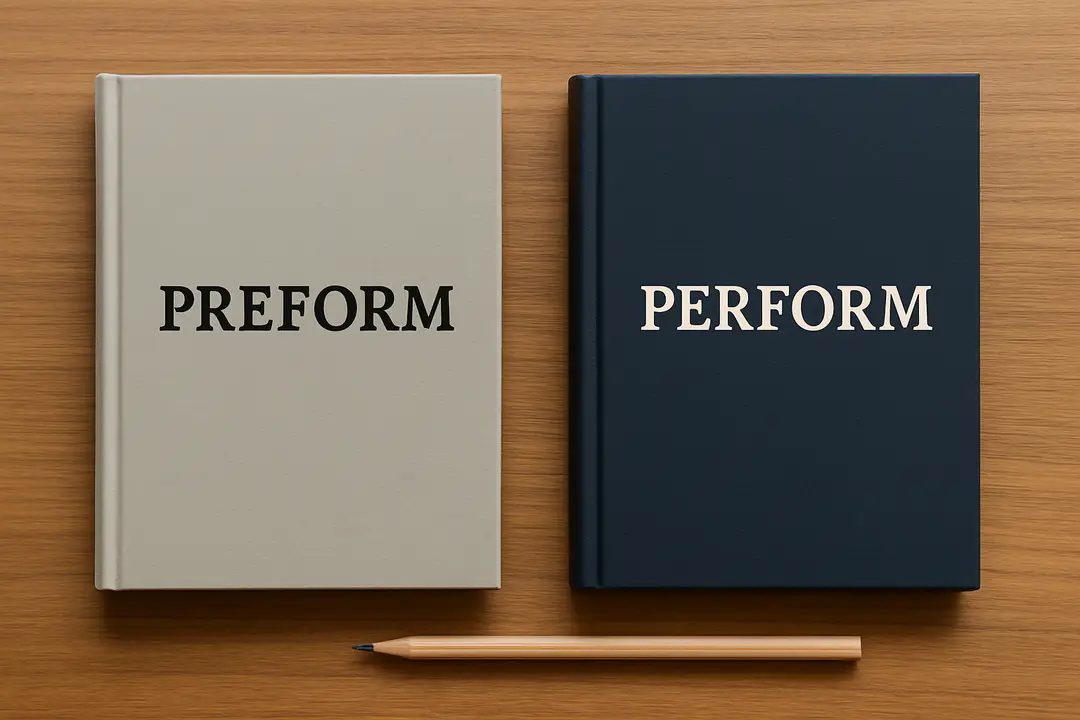

It’s easy to underestimate how much a tiny change in wording can shape what we say. In the world of writing and speech, the choice between preform and perform often slides past our radar. Most people know the basic definitions, but few pause to see how flipping a vowel or a consonant alters the whole sense. That shift can create confusion or even a different image in the reader’s mind. Have you ever wondered how using the wrong form of a word could throw off your message?
The answer lies in understanding each term fully and applying it in the right context. When you grasp why one directs attention to making a shape and the other focuses on carrying out an action, you avoid awkward statements. That clarity helps you write with confidence, saves time on edits, and prevents later explanations. Mastering this difference gives your words the precision they need to shine.
Why Small Differences Matter
Have you ever shaken your head when a simple word slip changes the meaning of a whole sentence? That little shift between preform and perform can trip up even seasoned writers. Knowing which one fits your idea keeps communication sharp and clear. When that subtle switch happens, readers can get confused or misled.
In a business email or a project report, choosing the wrong term can cast doubt on your expertise. A note that you preformed a task means something else entirely—and might leave colleagues scratching their heads. A good practice is to pause and think about the action you want to describe. That extra moment can save time spent on clarifications later.
Experts say that paying attention to word choice boosts credibility. Grammar tools, style guides, and simple cross-checks against reliable sources help catch these sneaky mistakes. It adds up: clear writing means fewer revisions and stronger results. Keep your audience in mind and aim for precision in every line.
Tip: keep a cheat sheet of often-confused word pairs. It might feel old school, but a quick glance can stop a misstep in seconds. You can also use online searches to see real-world examples. If a phrase feels off when you read it aloud, that often signals the wrong choice. Over time, you’ll train your eye to spot these small but powerful differences.
Roots of the Words
Both preform and perform come from Latin roots with the same base meaning related to “form.” The prefix pre- means “before,” so preform literally suggests shaping something ahead of time. Perform uses per-, which can mean “through” or “forward,” so it leans toward carrying out an action. That shared origin explains why the two words look so much alike.
Knowing these parts helps you make the right call. When you see pre- in front of a term, think about preparation and pre-making. In industrial settings, engineers preform metals before final assembly. Perform, on the other hand, invites energy and execution—a singer performs on stage, and a team performs a task.
Dictionary entries confirm these nuances. A quick look into a trusted lexicon can show example sentences and historical usage. If you notice perform being used with verbs like “execute,” “complete,” or “present,” you’ll remember it’s about action. If you spot preform in a technical description of materials or shapes, you’ll know it’s about making an initial form.
Practical tip: create flashcards that link words to images. Draw a mold for preform and a stage spotlight for perform. This simple visual trick sticks in your mind. When you face a sentence later, the picture will guide your spelling and usage.
Using Preform Correctly
Preform shows up most often in technical or manufacturing contexts. It refers to shaping or molding raw materials into a basic form before final processing. For example, plastic bottles often start as a preform—a small test-tube shape that is later blown into the full bottle. That early shape is crucial for control and quality.
Beyond plastics, you might see preform in metalwork and glassmaking. Engineers preform rods or sheets before bending, cutting, or welding. This step saves time when precision matters and makes the final work smoother. When you want to highlight that early stage, preform is the clear choice.
Here are some quick ways to remember when to use preform: 1. In manufacturing process descriptions. 2. When talking about a basic or preliminary shape. 3. In technical instructions or engineering notes.
Tip: if you are writing for a general audience, consider adding a brief definition when you use preform. That helps non-experts follow along and keeps your piece user-friendly. Precision becomes more accessible when you explain it clearly.
Using Perform Correctly
Perform is the word you reach for when talking about actions, tasks, or displays. It applies to everything from performing surgery to performing on stage. When you want to say that someone carries out a job or shows their skill, perform is the natural fit.
For example, a musician performs a song, a dancer performs a routine, and a surgeon performs an operation. Each time, the focus is on the action and the result. It conveys energy, intent, and completion. If you find yourself describing an event or task, perform will likely be the better choice.
An easy test is to swap in “carry out” or “execute.” If it makes sense, perform works. You would say a computer performs a calculation or a runner performs well in a race. If you try that swap with preform, it feels awkward or wrong.
Practical tip: when you write, double-check phrases like “perform a test” or “perform a check.” These are common in reports and technical writing. Maintaining consistency with perform avoids that embarrassing typo that invites extra comments.
Common Mix-ups & Fixes
It’s not just preform and perform that give writers pause. There are pairs like impatient and inpatient, exception and exemption, or even occasion and ocassion that sneak into our drafts. Spotting one error type helps train you to spot others. A side-by-side look can sharpen your eye.
| Word | Definition | Example |
|---|---|---|
| Preform | Shape beforehand | Technicians preform the component before final molding. |
| Perform | Carry out an action | The actor will perform the lead role tonight. |
When you see odd usage in your text, highlight suspect words and use tools like grammar checkers or a quick web search. If a term calls to mind a shape or a stage, let that guide you. Practice makes perfect. Soon these distinctions become second nature.
Another tip: share drafts with a colleague and ask them to flag uncertain words. A fresh pair of eyes often catches what you miss. By treating such mix-ups as training opportunities, you steadily build stronger writing habits.
Quick Usage Tips
Keep these simple checks in mind as you write:
- Read your sentence aloud. A wrong word often sounds off.
- Use a dictionary or trusted online source for a quick lookup.
- Create visual cues or flashcards for words you often confuse.
- Set your grammar checker to flag uncommon words.
- Ask a peer to read tricky passages.
- Review style guides if you write professionally.
By turning these steps into habit, you build confidence and reduce mistakes over time. Writing with precision becomes less about memorizing rules and more about following clear checks. Soon, preform versus perform bugs you less and less.
Conclusion
Choosing between preform and perform may seem like a minor detail, but it reflects your attention to clarity and professionalism. Every time you sit down to write a report, an email, or even a social post, remember that vocabulary shapes perception. By understanding the roots, usage contexts, and common traps, you make your writing stronger and more reliable.
Next time you ask yourself, “Did I use the right word?” pause and apply a quick check. Read your work aloud, consult a source, or lean on a checklist. These small habits add up, saving you edits and averting confusion. Whether you are crafting technical documents or casual notes, choosing the correct term conveys confidence and expertise.
Keep practicing and sharing what you learn with fellow writers. As you sharpen your eye, you’ll spot mix-ups in others’ writing and help them improve too. That ripple effect raises the quality of all your communication, one correctly chosen word at a time.


