
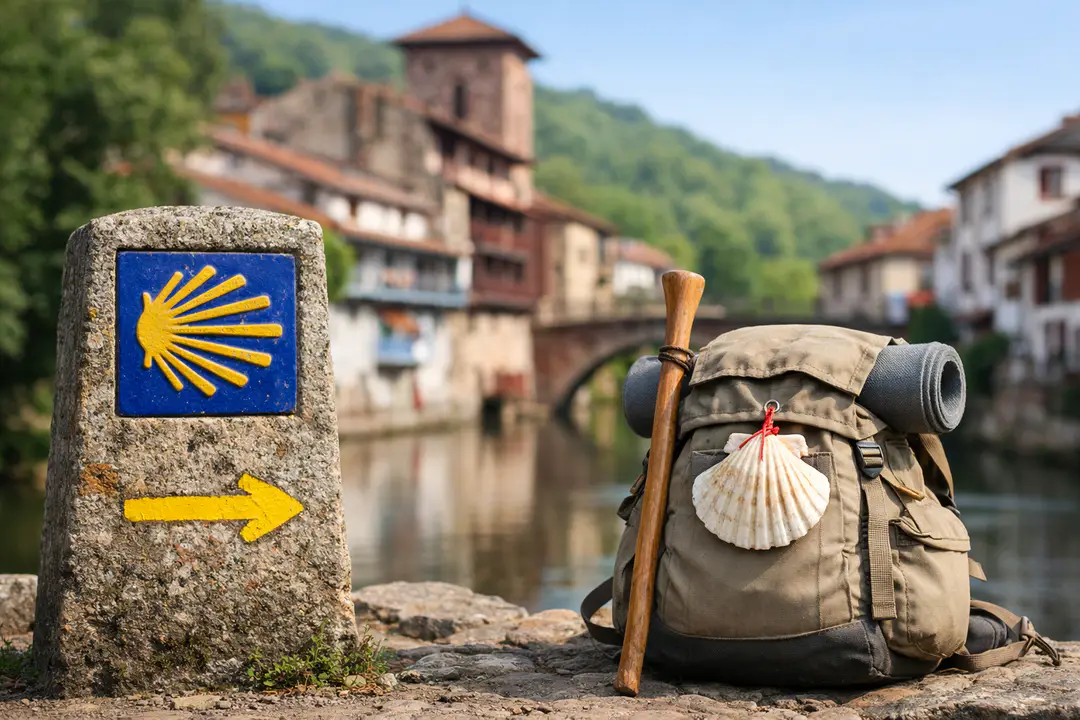

You arrive in Saint-Jean-Pied-de-Port as the afternoon light slides over medieval ramparts and the River Nive. A pilgrim with a fresh credential steps out of a tiny shop; a couple wheels their suitcase over cobbles toward the old gate. It’s easy to see why this small walled town is known as the gateway to the Camino Francés—and why so many travelers linger for its Basque character as much as for the walk ahead.
Saint-Jean-Pied-de-Port matters because it concentrates a surprising amount into a compact footprint: a UNESCO-listed medieval gate, a hilltop fortress, two signature streets that funnel you through town, and immediate access to the Pyrenees. It also sits at the heart of a very specific corner of the French Basque Country—Basse Navarre—with vineyards, mountain villages, and day hikes that reward even non-pilgrims.
This guide covers the essentials and the local details that make planning easier: the best sights and viewpoints, how to get here (train/bus/car), realistic Camino logistics for day one, what to eat and drink (including Irouléguy and AOP Irouléguy), and nearby excursions such as GR 10 walks, Harpea Cave, and the ridge above Roncesvalles. I’ve organized it so you can scan, decide, and travel with confidence.
What Is Saint-Jean-Pied-de-Port? / Overview
Saint-Jean-Pied-de-Port is a fortified market town in the French Basque Country, set at the foot of the Pyrenees near the Spanish border. It serves as the historic capital of Basse Navarre (Lower Navarre) and the practical pilgrimage starting point for many walkers beginning the Way of St James via the Camino Francés.
The town was founded in the 12th century and developed as a strategic border settlement. It also replaced the original Saint-Jean-le-Vieux after that earlier site was destroyed—an episode tied to conflicts in the era associated with Richard the Lionheart. What you see today is the result of centuries of border politics: a compact old town wrapped in medieval ramparts, crowned by a citadel, and stitched together by two cobbled spines—Rue de la Citadelle and Rue d’Espagne—that lead you down toward the river.
Two route names matter here. First, pilgrims follow GR 65 (the French long-distance trail that overlaps with the Camino routes) through town and onward toward Spain. Second, hikers will notice how close you are to the high-country options of the Pyrenees, including sections connected to GR 10 (the trail that traverses the French Pyrenees).
Why it’s important: Saint-Jean-Pied-de-Port is both a living town and a staging ground. You can treat it as a one-night logistical stop—or as a base for exploring the Pays de Saint-Jean-Pied-de-Port, the nearby Valley of Saint-Etienne-de-Baïgorry, and villages like Mendive, Béhorléguy, and Lecumberry before or after your Camino days.
Quick facts: What to know before you go
If you plan around terrain and timing, Saint-Jean-Pied-de-Port is straightforward. The old town is small and walkable, but the surroundings are mountainous and weather shifts quickly.
- Setting: French Basque Country (Basse Navarre), beside the River Nive, at the foot of the Pyrenees.
- Historic core: Walled medieval town; key streets are Rue de la Citadelle (upper) and Rue d’Espagne (lower).
- Signature landmark: Porte Saint Jacques, a 15th-century gate that is UNESCO World Heritage-listed.
- Fortifications: The Citadelle was strengthened in the 18th century with works associated with Vauban as part of Louis XIV–era border defenses.
- Pilgrimage routes: Major start for the Camino Francés; route through town corresponds with GR 65.
- Best seasons: Spring and early autumn for comfortable walking; summer brings crowding and hotter afternoons.
- Practical reality: Limited accommodation in peak months—book early if you want a private room, and arrive early if you need a bed in an albergue.
Common planning mistakes (and easy fixes)
- Underestimating day one: The crossing to Roncesvalles is a serious mountain day. Fix: start early, pack layers, and pick the route that matches weather and fitness.
- Assuming taxis are always available: They exist, but not like in big cities. Fix: pre-book if you have an early train/bus or tight schedule.
- Arriving without cash: Cards are widely accepted, but small pilgrim services can be cash-friendly. Fix: use an ATM before you’re rushing.
Local tip: If you’re arriving late, buy a simple dinner plan (sandwich, fruit, yogurt) before shops close—especially on Sundays—so you’re not searching with a headlamp after check-in.
Top 8 things to see in Saint-Jean-Pied-de-Port
The joy here is how quickly you can connect the dots: gate → streets → river → ramparts → citadel viewpoints. Plan 2–4 hours for a satisfying first pass, longer if you add museums or a long rampart walk.
- Porte Saint Jacques: The town’s most symbolic threshold. This 15th-century gate is UNESCO World Heritage-listed and sits on the pilgrim approach. Stand back to see how the ramparts frame it, then pass through slowly—most visitors rush the moment.
- Rue de la Citadelle: The upper cobbled street, lined with old stone facades, small shops, and pilgrim services. It’s also the quickest walking line toward the citadel hillside, so you’ll naturally end up here.
- Rue d’Espagne: The lower parallel street, closer to the river. It’s a better evening stroll when the heat drops, and you’ll find several inviting terraces along the way.
- Medieval ramparts walk: Follow the wall segments for changing angles over rooftops and the Nive valley. Even a short loop gives you a sense of why this was a border stronghold.
- The Citadelle (external viewpoints): Access inside can vary, but the hillside around the Citadelle is worth the climb for broad views into the Pyrenees and down to the old bridge.
- River Nive banks and bridges: The river softens the town’s fortress feel. Cross the bridges for classic postcard angles back toward the walls—best in late afternoon.
- Pilgrim offices and credential points: Even if you’re not walking, they’re part of the town’s daily rhythm. Watch the morning flow of packs and walking poles; it’s a living tradition, not a staged scene.
- Market-life in the old town: If you catch a market morning, focus on Basque cheeses, cured meats, and seasonal fruit—perfect for a picnic by the river.
A simple self-guided route (90 minutes)
- Start at Porte Saint Jacques → walk up Rue de la Citadelle → climb for citadel viewpoints → return via ramparts → finish on Rue d’Espagne by the River Nive.
Local tip: For photography, go early or late. Midday sun flattens the texture of stone streets; golden hour brings out the warm tones in the ramparts.
How to get there (train, bus, car) and practical tips
Saint-Jean-Pied-de-Port is small, but it’s not isolated—connections are just less frequent than on the coast. Build a little flexibility into arrival day, especially if you’re coordinating with Camino start times.
- By train: Regional services connect via larger hubs (often through Bayonne area connections). The station is close enough to walk into town with a backpack; with rolling luggage, allow extra time on cobbles.
- By bus: Seasonal and regional buses can be useful, but schedules vary. Confirm the latest timetable a day or two before travel.
- By car: Driving gives you freedom to explore the Pays de Saint-Jean-Pied-de-Port and the Valley of Saint-Etienne-de-Baïgorry. Parking near the old town can fill in summer; choose a lot and walk in.
- Getting around: The historic center is best on foot. For vineyards and villages like Mendive, Béhorléguy, and Lecumberry, a car or local taxi is most efficient.
Arrival-day checklist
- Cash + card: Have both for small purchases and pilgrim services.
- Water plan: Buy a bottle and refill as possible; heat builds fast in the valley.
- Footwear reality check: Cobbles can be slick in rain—test your shoes before the Camino day.
Where to base yourself: old town vs. outskirts
- Old town: Best for atmosphere, restaurants, and early Camino starts. Expect some night noise in peak season.
- Outskirts: Quieter, often easier parking. Plan a 10–25 minute walk back to dinner.
When mapping out transport days, it helps to borrow a few comfort-first planning habits—the same logic applies to travel: reduce friction, keep essentials accessible, and avoid last-minute scrambles.
Local tip: If your first Camino stage starts tomorrow, aim to arrive by mid-afternoon. You’ll have time to sort supplies, eat early, and sleep before the pre-dawn departures.
Starting the Camino Francés from Saint-Jean-Pied-de-Port
For many pilgrims, Saint-Jean-Pied-de-Port is the emotional and logistical “start line.” The town is built around that rhythm: credential stamps, gear shops, early breakfasts, and a morning exodus toward the mountains.
- Route marker basics: In this region, the Way of St James uses recognizable markers and overlaps with GR 65. Learn what you’re following before you leave town.
- Most common first-day goal: Roncesvalles (in Spain). It’s a demanding day for most walkers.
- Timing: Many pilgrims start very early to avoid heat and to build a safety buffer for weather.
Step-by-step: a calm, efficient Camino morning
- Prepare tonight: Pack, lay out layers, and separate snacks/water so you’re not repacking at 6 a.m.
- Check the forecast: Mountain weather can switch quickly. Wind and fog change both comfort and navigation.
- Eat early: Even a small breakfast helps on the first big climb.
- Start steady: The first hour should feel “too easy.” If you go hard early, the climb will punish you later.
Choosing a first-day approach (and what people get wrong)
- Common mistake: Treating day one like a normal stroll because the town feels gentle. Reality: you’re crossing the Pyrenees; it’s a real mountain stage.
- Common mistake: Underpacking layers in summer. Reality: wind and rain can hit at higher elevations even when the valley is warm.
- Tip: If you’re uncertain, talk to your accommodation host or pilgrim office the day before. They’ll often give the most practical advice on current trail conditions.
Pilgrim note: A “good” first day isn’t the fastest day. It’s the day you finish healthy enough to enjoy day two.
Local tip: If you’re traveling with a group, agree on regroup points (a chapel, a pass, a café) rather than trying to walk in a tight pack. It reduces stress and keeps everyone moving at their own sustainable pace.
Where to eat and what to try: Basque dishes and Irouléguy wine
Food in Saint-Jean-Pied-de-Port is a blend of practical pilgrim fuel and distinctly Basque flavors. If you’re walking the next day, you don’t need a heavy feast—but you do want quality ingredients and enough protein.
- Basque charcuterie: Look for local cured meats (often paired with pickles or simple salad).
- Sheep’s milk cheese: Often served with a sweet accompaniment (jam or cherry preserves). Great for a picnic.
- Trout and river fish: A lighter dinner option that still feels “regional.”
- Hearty countryside plates: Stews and braises appear on cooler days—ideal if rain is forecast for your Camino stage.
- Wine: Order Irouléguy by the glass when available, or ask specifically for AOP Irouléguy to taste what this small appellation does best.
Understanding Irouléguy (and how to order it)
Irouléguy is produced on steep vineyard slopes nearby, with bottles that can be more limited than you’d expect in a tourist town. In restaurants, you may see it listed as red, white, or rosé under AOP Irouléguy. If you enjoy wine, it’s worth trying a glass here rather than waiting for larger cities, where selection can be generic.
Practical dining tips for pilgrims
- Eat earlier than you’re used to: You’ll sleep better before an early start.
- Build a next-day snack kit: Fruit, nuts, a small sandwich, and something salty. Don’t rely on finding open cafés in the mountains.
- Hydrate smartly: Pair wine with water, especially if you’re crossing to Roncesvalles tomorrow.
Local tip: If you want a memorable, low-effort dinner, ask for a “menu” option that emphasizes regional products. You’ll usually get better value and a clearer Basque identity than ordering at random.
Day hikes and nearby attractions (GR 10, Urkulu, Harpea Cave)
If you have an extra day (or you’re not walking the Camino), the surrounding region is where Saint-Jean-Pied-de-Port really opens up. You can choose anything from a short riverside walk to a high viewpoint with big Pyrenees horizons.
- GR options: Sections and connections that relate to GR 10 (Pyrenees traverse) and GR 65 (Way of St James routes).
- Mountain landmarks: Urkulu and Harpea Cave are popular for good reason—distinct landscapes and strong sense of place.
- Villages and valleys: The Valley of Saint-Etienne-de-Baïgorry is ideal for a half-day wine-and-scenery loop.
Mini-profiles: choose your outing
- Urkulu (Orkulo) viewpoint: Time: half-day. Difficulty: moderate (steady uphill, exposed in places). Why go: big borderland views and a sense of the Pyrenees as a natural boundary. Tip: bring wind protection even in summer.
- Harpea Cave (Harpeako koba): Time: half-day. Difficulty: easy-to-moderate depending on access point. Why go: a dramatic rock shelter that feels geological and cultural at once. Tip: after rain, expect mud and slippery rock.
- GR 10 day segment: Time: 3–6 hours depending on chosen section. Difficulty: moderate. Why go: classic ridge walking and a taste of the long-distance Pyrenees route without committing to weeks.
- Valley of Saint-Etienne-de-Baïgorry + Irouléguy vineyards: Time: half-day to full day. Difficulty: easy (driving with short walks). Why go: landscape, wine culture, village life. Tip: call ahead for tastings—small producers don’t always keep open hours like large wineries.
- Mendive / Béhorléguy / Lecumberry village loop: Time: half-day. Difficulty: easy. Why go: quiet roads, farm views, and a deeper feel for the Pays de Saint-Jean-Pied-de-Port beyond the ramparts.
Safety and timing in the Pyrenees
- Weather: fog and storms can roll in fast—turn around if visibility collapses.
- Navigation: download offline maps; don’t assume phone service.
- Seasonal access: some roads/tracks can be restricted or rough—ask locally before committing.
Local tip: If you’re undecided, pick one “high” objective (Urkulu or a GR ridge) and one “low” objective (valley villages). It balances exertion and gives you both landscapes in a single trip.
Where to stay: hotels, albergues and guesthouses
Accommodation in Saint-Jean-Pied-de-Port is shaped by pilgrimage demand. The best approach is to decide what kind of night you need—social and early, or quiet and restorative—then book accordingly.
- Albergue: Dorm-style, pilgrim-focused, budget-friendly, and social. Often strict about quiet hours.
- Guesthouse / B&B: More comfort and local hosting, often includes breakfast that’s useful for early departures.
- Small hotels: Private rooms and easier late check-in, sometimes with luggage storage or early breakfast options.
What to prioritize (by traveler type)
- Pilgrim starting tomorrow: location near old town routes, early breakfast, secure bag storage, and a calm environment.
- Non-pilgrim weekend traveler: a room with views, parking access, and walkable dining on Rue d’Espagne or near the river.
- Group / family: family rooms or an apartment-style stay to avoid splitting up at night.
Budget guide (typical ranges)
| Type | Best for | What you get | Planning note |
|---|---|---|---|
| Albergue | Pilgrims, solo travelers | Bunk bed, shared bath, communal vibe | Arrive early in peak season |
| Guesthouse / B&B | Couples, comfort-focused | Private room, often breakfast | Book ahead for summer |
| Small hotel | Short stays, late arrivals | Private room, reception support | Check check-in hours |
| Apartment-style | Families, longer stays | Kitchenette, space | Great for rest days |
Common booking mistakes
- Assuming you can always find a bed on arrival: in peak Camino season, that’s risky. If you want certainty, reserve.
- Choosing a loud location before an early start: being near lively terraces can backfire when you need sleep.
- Not asking about bag storage: especially if you’re arriving before check-in or leaving after check-out.
If you’re comparing digital tools and booking confirmations on the go, be cautious about public Wi‑Fi and shared-device privacy—a quick login at a café is convenient, but it’s worth basic security hygiene when you’re handling payments and identity documents.
Local tip: If you’re starting the Camino, consider staying within a few minutes’ walk of your planned exit route from town. That small choice can reduce morning stress more than any gear upgrade.
Practical tips / Best practices for a smooth visit
Saint-Jean-Pied-de-Port rewards travelers who plan lightly but specifically: know your priorities (history, Camino logistics, food, or hikes) and match your schedule to them.
- Give the town at least one evening: Even if you arrive for the Camino, an unrushed walk along the River Nive and through Rue de la Citadelle helps you settle.
- Book strategically: If you want a private room in summer, reserve early. If you prefer an albergue, arrive early and keep a backup option.
- Eat with tomorrow in mind: Choose a satisfying dinner, but don’t overdo alcohol before the climb toward Roncesvalles.
- Pack layers year-round: The valley can feel mild while higher elevations are windy and cold.
- Start early for big days: Whether it’s the Camino crossing or a hike like Urkulu, morning hours give you the best light and the safest buffer.
- Respect the streets: Cobblestones plus rain equals slips. Walk deliberately, especially with a full pack.
Things to avoid
- Overplanning every hour: the town is best when you allow time for a long lunch or an unplanned viewpoint detour.
- Ignoring rest: many first-day Camino injuries are simply fatigue plus ego. Pace beats ambition.
- Skipping local context: learn the basics of Basse Navarre and the border history—your walk through the ramparts will make more sense.
Expert approach: If you have only one full day here, split it into three blocks: (1) ramparts + Porte Saint Jacques in the morning, (2) lunch and Rue d’Espagne browsing, (3) sunset viewpoints near the Citadelle. It’s simple, realistic, and hits what most travelers actually remember.
FAQ
How many days do I need in Saint-Jean-Pied-de-Port?
One night is enough for Camino logistics and a quick town walk. Two nights lets you enjoy the ramparts, eat well, and add a half-day outing into the Valley of Saint-Etienne-de-Baïgorry or a short GR 10-style hike. If you’re not walking the Camino, a weekend is ideal.
Is Porte Saint Jacques really UNESCO-listed?
Yes. Porte Saint Jacques is a 15th-century gate and is included within the UNESCO World Heritage listing associated with the major routes of the Way of St James in France. It’s a key landmark for pilgrims passing through town.
What’s the relationship between Camino Francés and GR 65?
Camino Francés is the famous route to Santiago once you cross into Spain. In France, the path network is often waymarked under long-distance trails; GR 65 is the key designation you’ll see associated with the pilgrim route approaching and passing through Saint-Jean-Pied-de-Port.
Can I do the first Camino day to Roncesvalles if I’m not very fit?
It depends on your baseline fitness, pack weight, and weather. The crossing to Roncesvalles is challenging for many first-timers. If you’re unsure, reduce pack weight, start early, and consider breaking the day into shorter stages if your itinerary allows. Local advice the day before is invaluable.
What is Irouléguy wine, and where do I try it?
Irouléguy is a small mountain appellation near Saint-Jean-Pied-de-Port. Ordering a glass of AOP Irouléguy at dinner is the easiest way to try it. If you have a car and time, head into the nearby valleys for tastings—but call ahead because opening hours can be limited.
Conclusion
Saint-Jean-Pied-de-Port works on two levels: it’s a beautifully preserved fortified town—with Porte Saint Jacques, the Citadelle, and cobbled lanes like Rue de la Citadelle and Rue d’Espagne—and it’s a practical launchpad into the Pyrenees. Whether you’re here to begin the Camino Francés along GR 65, to sample AOP Irouléguy and Basque cooking, or to explore day hikes connected to GR 10, the key is to match your plan to the terrain and timing.
Give yourself enough margin: arrive early, sleep well, and keep day one ambitions realistic—especially if you’re crossing toward Roncesvalles. Then use any extra hours to explore beyond the walls into the Pays de Saint-Jean-Pied-de-Port, the Valley of Saint-Etienne-de-Baïgorry, and nearby villages like Mendive, Béhorléguy, and Lecumberry.
Next step: decide your “core trip”—one evening in town, a Camino start, or a weekend base—and book the accommodation style that supports it. Saint-Jean-Pied-de-Port rewards travelers who keep it simple, walk slowly, and pay attention to the landscape that’s shaped this border town for centuries.


