
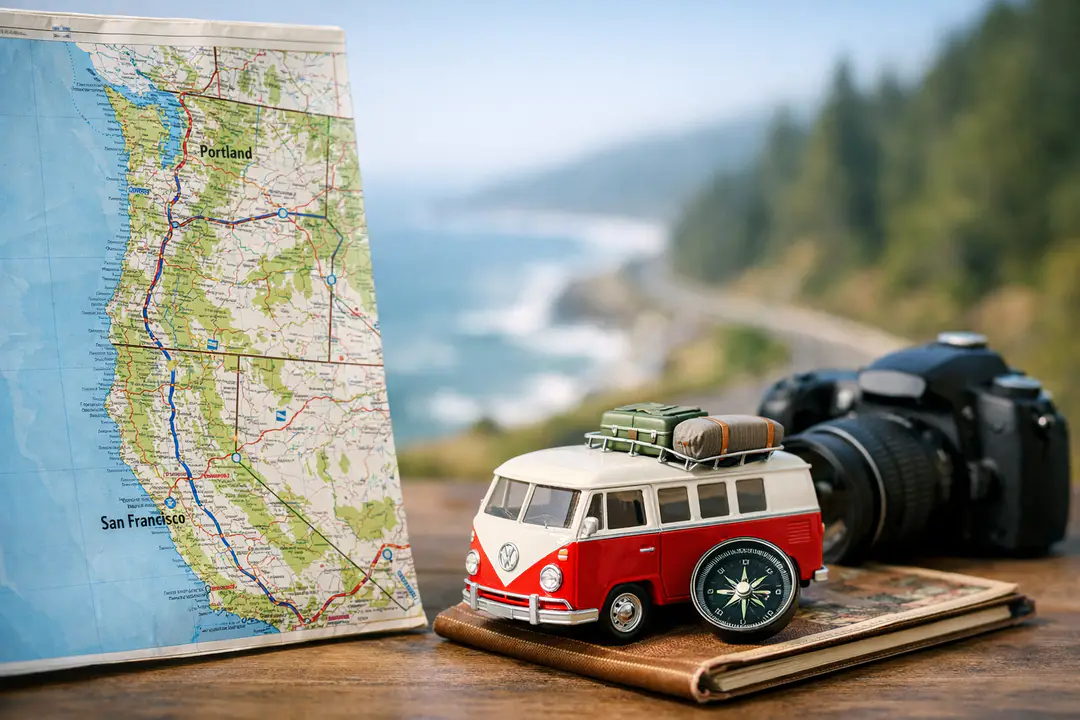

You know that feeling when you cross the Golden Gate Bridge, glance left at the bay, and suddenly the city noise drops away? That’s the moment this road trip really starts. Within a few hours you’ll trade San Francisco’s skyline for foggy headlands, sea stacks, and redwood groves that make your car feel tiny—in the best way.
A road trip from San Francisco to Portland, Oregon is more than “just driving north.” It’s a choose-your-own coastal story: Highway 1’s cliff-hugging curves, US-101’s classic Pacific Coast route rhythm, quick detours to lighthouses and state parks, and a few nights where the best plan is simply to watch the sunset from a viewpoint with snacks on the hood.
In this guide, I’ll lay out the practical deliverables travelers actually need: total distance and realistic drive time, a recommended 8–12 day day-by-day itinerary, route options (Highway 1 vs US-101), must-see stops (including Avenue of the Giants and Founders Grove), where to stay (from inns to campground overnights), and how to make it work in a campervan. You’ll also get a simple road trip map approach plus Google Maps + GPX planning tips, so you can drive it confidently.
What Is a San Francisco to Portland Road Trip? (Overview)
This road trip is a scenic drive up the Northern California and Oregon coasts—typically following the Pacific Coast route on US-101 with optional stretches of Highway 1—finishing in Portland after you’ve soaked up beaches, redwoods, small fishing towns, and rugged viewpoints.
The point isn’t speed; it’s the pacing. The direct freeway route (I-5) can get you from SF to Portland faster, but it skips the very things that make this drive special: misty headlands, tide pools, lighthouses, and redwood-lined roads where you’ll pull over “just for a minute” and lose an hour.
Key concepts to understand before you plan:
- Route choice shapes your trip: Highway 1 is slower and dramatic; US-101 is the backbone for coastal towns and redwood access.
- Drive time is elastic: A “4-hour leg” easily becomes 6 with photo stops and state park walks.
- Overnight towns matter: Choosing the right overnights reduces backtracking and helps you catch the coast at golden hour.
- Season changes everything: Summer has longer days (and higher prices). Shoulder seasons can be perfect—if you plan for fog, rain, and occasional road work.
Why it’s important: this is a long, linear trip—over 650 miles of open road to explore—and the biggest difference between “stressful” and “smooth” is planning your leg distance and stops so you’re not arriving after dark every night. With the right day-by-day itinerary, you’ll get the best views and enough time out of the car to enjoy them.
1. Quick Stats & Trip Planning (Distance, Time, Pace)
If you’re deciding whether this route is realistic for your schedule, start with the numbers. The coastal version of a road trip from San Francisco to Portland is typically ~650 miles (often a bit more once you add detours and scenic loops). The biggest planning mistake is treating that number like a simple point-to-point drive; the coast is slower by design.
Travellers Autobarn (with travel writer Bastian Graf) commonly recommends 8–12 days for this trip, which aligns with what I see work best in real life: you’ll drive most days, but you won’t feel like you’re only collecting gas receipts.
| Trip length | Who it’s best for | What it feels like |
|---|---|---|
| 6–7 days | Fast movers, limited PTO | Long drive days; fewer hikes; more “arrive, sleep, repeat” |
| 8–12 days | Most travelers | Balanced: daily stops + time for redwoods, beaches, and viewpoints |
| 13–16 days | Slow travel, photography, campervan life | Multiple 2-night stays; room for weather and spontaneous detours |
Reality check on drive time: even when Google Maps says “3 hours,” plan for 20–40% extra if you’ll stop at overlooks, lighthouses, and state parks. Parking, short walks to viewpoints, and snack stops add up.
Planning checkpoints (so the trip stays fun)
- Cap drive days at ~4 hours when possible; save 5–6 hour days for transitions.
- Book 2–3 key overnights early (redwoods area, Oregon coast weekend, Portland).
- Build “flex time” for foggy mornings, road work, or a beach you don’t want to leave.
Common mistake: trying to “do” both Highway 1 and US-101 end-to-end. It’s better to choose a primary route and sprinkle in short scenic segments as detours, rather than committing to the slowest roads every single day.
2. Highway 1 vs US-101 — How to Choose Your Route
Your two headline options are Highway 1 and US-101, and most great itineraries use a blend. Think of US-101 as the reliable spine of the Pacific Coast route (towns, services, straightforward navigation). Highway 1 is the scenic drive you take when you want drama: cliffs, coves, and frequent “pull over right now” moments.
| Route | Best for | Trade-offs |
|---|---|---|
| Highway 1 | Big coastal views, photography, short scenic stretches | Slower; tighter curves; occasional closures/repairs; fewer fast services |
| US-101 | Covering ground, coastal towns, redwood access, easier logistics | Some inland stretches; fewer “cliff edge” moments than Highway 1 |
A practical blend that works
- Day 1–2: Use Highway 1/shore roads for Marin, Point Reyes, and a relaxed coastal start.
- Mid-trip: Settle into US-101 for redwoods (Avenue of the Giants) and efficient northbound progress.
- Oregon: US-101 is the main event—beaches, viewpoints, and classic seaside towns.
Common mistake: choosing Highway 1 because it sounds “more scenic,” then realizing you’re arriving after dark and missing the very views you came for. If you want maximum scenery, choose fewer Highway 1 segments, but drive them in daylight and give yourself time to stop.
Another tip: if you’re traveling in a campervan, US-101 can feel more comfortable on long days—wider lanes, easier passing, and more frequent fuel and grocery options. Save Highway 1 for shorter legs or morning-to-afternoon stretches when you’re not racing sunset.
3. Day-by-Day Itinerary (8–10 Days) — SF to Portland
This day-by-day itinerary is built for an 8–10 day pace: steady forward movement, daily highlights, and enough slack for beaches and short hikes. You can stretch it to 12 days by adding the Mendocino/Fort Bragg detour and/or a second night in the redwoods.
Day 1: San Francisco → Avenue of the Giants (5+ hours) — redwoods right away
Highlight: Go from city to giant trees in a single day; it’s a classic “wow” opener.
Drive time / leg distance: Around 5+ hours, depending on stops and whether you start via Highway 1 or US-101.
- Where to stop:
- Golden Gate Bridge photo pull-offs
- Sausalito waterfront coffee or early lunch
- Optional quick coastal peek before committing north
- How long to spend: Plan 1–2 hours for your first redwood walks once you arrive.
- Where to stay: Miranda/Weott area (easy access to Avenue of the Giants), or nearby small inns; campervan travelers can look for a campground close to the corridor.
Practical tips: Aim to arrive with daylight for your first grove walk—redwoods feel completely different at 6 p.m. than at 9 p.m. after a long drive. Fill up on fuel before the more rural stretches.
Day 2: Avenue of the Giants + Founders Grove → Trinidad (short drive) — slow down
Highlight: A low-mileage day that’s all about being in the forest, not driving past it.
Drive time / leg distance: 1–2 hours total, depending on how many stops you do along the scenic drive.
- Where to stop:
- Avenue of the Giants pull-outs and short loops
- Founders Grove for an easy, iconic walk
- Humboldt Redwoods State Park day-use areas
- How long to spend: 3–5 hours across a few short walks beats one rushed “big hike.”
- Where to stay: Trinidad (coastal views), or Eureka/Arcata for more dining options; campervan overnights are easiest where campgrounds have solid facilities.
Practical tips: Redwoods are cool and damp year-round; pack a light layer even in summer. Common mistake: driving the whole Avenue of the Giants without stopping—pick 3–5 stops and actually get out.
Day 3: Trinidad → Crescent City / Jedediah Smith area — beaches + more giants
Highlight: Rugged coastline plus lush, river-fed redwood groves.
Drive time / leg distance: ~2.5–3.5 hours with stops.
- Where to stop:
- Coastal viewpoints near Patrick’s Point area
- Short beach walk for tide pooling (check tide tables)
- Redwood groves near the Smith River (Jedediah Smith area)
- How long to spend: 2–4 hours split between a beach + one standout grove.
- Where to stay: Crescent City for convenience, or a nearby campground if you’re in a campervan.
Practical tips: Fog can roll in fast; keep headlights on in low visibility. If you’re driving a larger campervan, take your time on narrow coastal pull-offs and don’t force a parking spot—find the next one.
Day 4: Crescent City → Brookings, OR + Samuel H. Boardman Scenic Drive — viewpoints day
Highlight: Oregon’s south coast starts strong—this is where you’ll stop every 10 minutes.
Drive time / leg distance: ~1–2 hours of driving, plus lots of short walks.
- Where to stop:
- Samuel H. Boardman Scenic Corridor viewpoints and short trails
- Natural bridges and secluded coves (choose 2–3 so you’re not rushed)
- Quick picnic overlooking the water
- How long to spend: Half a day is easy here; it’s made for wandering.
- Where to stay: Brookings/Harbor area (good base), or a coastal campground for an ocean-sound overnight.
Practical tips: Don’t underestimate wind chill at viewpoints. Common mistake: trying to see every pull-out—pick your favorites and linger.
Day 5: Brookings → Bandon / Coos Bay — sea stacks and a mellow beach town overnight
Highlight: Classic Oregon coast scenery with wide beaches and dramatic rock formations.
Drive time / leg distance: ~3–4 hours with stops.
- Where to stop:
- Beach walks and photo stops along US-101
- Bandon’s waterfront and sea stack viewpoints
- Optional lighthouse stop if timing works
- How long to spend: 1–2 hours in Bandon plus a beach sunset if you can.
- Where to stay: Bandon for charm, or Coos Bay for more lodging inventory; campervan travelers should check for wind-protected campground spots.
Practical tips: This is a good resupply day: groceries, laundry, and a slower evening. If you’re in a campervan, top up water and propane where available—services can be spaced out.
Day 6: Bandon / Coos Bay → Newport — lighthouses + coastal towns
Highlight: A full Oregon coast day: lighthouses, viewpoints, and walkable waterfronts.
Drive time / leg distance: ~4–5 hours with stops.
- Where to stop:
- At least one lighthouse (plan around hours/parking)
- Short coastal hikes in a state park en route
- Newport’s bayfront for seafood and a sunset stroll
- How long to spend: 2–3 hours in Newport if you want a relaxed evening.
- Where to stay: Newport (central, practical), or nearby smaller towns if you prefer quiet; book ahead in summer.
Practical tips: Common mistake: stacking too many “cute towns” in one day. Choose one main town (Newport works well) and treat the others as quick coffee/photo stops.
Day 7: Newport → Cannon Beach / Manzanita — the photogenic north coast stretch
Highlight: Big sandy beaches and iconic coastal rock formations.
Drive time / leg distance: ~3–4 hours, plus beach time.
- Where to stop:
- Several north-coast viewpoint pull-offs
- Beach walk and tide pools (if conditions are safe)
- Small galleries/shops if you want a non-hiking afternoon
- How long to spend: 2–4 hours on the beach; it’s worth arriving before late afternoon.
- Where to stay: Cannon Beach for walkability, Manzanita for quieter vibes, or nearby campgrounds for a final coastal overnight.
Practical tips: Parking can be tight on weekends. Arrive earlier, or park once and walk. If you’re sensitive to crowds, stay slightly south and day-trip in.
Day 8: North Coast → Portland — finish with food and neighborhoods
Highlight: A short final drive, then shift into city mode (coffee, bookstores, and dinner you didn’t cook).
Drive time / leg distance: ~1.5–2.5 hours depending on where you slept.
- Where to stop:
- One last coastal viewpoint before turning inland
- Optional quick stop in a riverside town en route
- In Portland: a neighborhood wander and a solid meal
- How long to spend: At least 2 nights in Portland if you can—one night goes fast.
- Where to stay: Central neighborhoods for walkability; campervan travelers should plan legal overnight parking or choose an RV-friendly site outside the core.
Practical tips: Don’t schedule a late arrival and then try to “see Portland” that night. Drop the vehicle, check in, and keep your first evening simple.
4. Must-See Stops (and How to Actually Enjoy Them)
The coast is full of “top 10” lists, but the stops that land best are the ones you can pair with realistic drive time and a clear plan: park, walk, look, snack, move on. Here are the anchors that consistently deliver on this route, plus how to experience them without rushing.
San Francisco start: Golden Gate Bridge + Sausalito
- Concept: Start with a clean break from the city; it sets the tone for the week.
- Practical application: Cross early to beat traffic, then grab coffee in Sausalito before heading toward the coast.
- Mistake to avoid: Spending half the day on city errands. Do your big grocery run the night before.
Point Reyes National Seashore (easy add-on, huge payoff)
Point Reyes is close enough to be your first “coastal wow” without committing to a long detour. Travellers Autobarn notes it’s only 37 miles from San Francisco, which makes it one of the easiest early upgrades to your road trip map.
- Where it shines: Beaches, headlands, and that feeling of being far away surprisingly fast.
- Tip: Choose one main hike/walk and one viewpoint, rather than trying to crisscross the whole seashore.
Bodega Bay + coastal pull-offs
- Concept: This is where your Pacific Coast route rhythm starts—small towns, salty air, and simple seafood meals.
- Practical tip: Plan a 30–60 minute stop, not a half-day (unless you’re staying nearby).
Avenue of the Giants + Founders Grove (the redwood core)
- Concept: A scenic drive that’s only worth it if you get out of the car multiple times.
- Practical application: Pick a handful of stops, including Founders Grove, and give each one 20–40 minutes.
- Mistake to avoid: Saving the groves for “tomorrow.” Weather shifts; do the best sections when you’re there.
Samuel H. Boardman Scenic Corridor (Oregon’s showstopper viewpoints)
- Tip: It’s easy to underestimate time here. Even “quick” viewpoints often involve short trails and stairs.
- Parking note: Popular pull-outs fill midday; morning and late afternoon are calmer.
Local-expert mindset: instead of chasing every named spot, aim for a daily “theme” (redwoods day, lighthouse day, beach day). You’ll remember the feeling of each day more than a checklist of signs.
5. Optional Detours & Side Trips (Add Time Where It Counts)
Detours can make this road trip, but only if you budget them honestly. A detour that looks small on the map can add a full day once you factor in slower roads, photo stops, and the fact that you’ll want to linger.
Detour: Mendocino + Fort Bragg (add 1 full day)
If you want a coastal town that feels like you could stay forever, Mendocino is the one. Miss Rover-style itineraries often flag this as the optional add-on because it’s scenic and distinctive—but it needs time.
- Drive time: San Francisco to Mendocino is about ~3.5 hours without heavy stops.
- Recommended added time: Budget at least an extra full day to do it right (overnight there, not a rushed out-and-back).
- What to do: Coastal bluffs walk, small galleries, and a relaxed dinner; continue to Fort Bragg for beaches and a no-stress morning.
Detour: More redwoods (add 0.5–1 day)
- Concept: If you love forests, add a second night near the Avenue of the Giants corridor.
- Practical application: Swap a long coastal push for a short drive day with multiple grove walks.
Detour: Lighthouses and longer beach walks (add 2–4 hours per stop cluster)
- Tip: Group lighthouse stops by region, otherwise you’ll spend more time parking than enjoying them.
- Common mistake: Driving to three lighthouses in one day “because they’re on the way.” Choose one standout lighthouse and pair it with a nearby state park trail.
Detour: Inland shortcut day (strategic, not scenic)
Sometimes weather is socked in or you’re behind schedule. In that case, consider a partial inland hop (short US-101 to faster roads) to reset your timeline, then rejoin the coast when you can appreciate it again. The goal is to protect your best scenic drive segments for daylight and decent visibility.
Rule of thumb: add detours only when they improve the experience of a day, not just the number of places you can name afterward.
6. Where to Sleep: Inns, Campgrounds, and Campervan Overnights
Your lodging strategy will shape your whole trip. Coastal towns can book out early in summer, and prices jump on weekends. A little structure—especially around the redwoods and the Oregon coast—makes the trip feel easy.
Best “base towns” for a smooth day-by-day itinerary
- Redwoods (Avenue of the Giants area): Convenient for early-morning grove walks and low-stress parking.
- Trinidad / Arcata: Good food options plus quick access to beaches and forests.
- Brookings (OR): Ideal for Samuel H. Boardman Scenic Corridor viewpoints.
- Newport (OR): Central Oregon coast base with waterfront dining.
- Cannon Beach / Manzanita: Walkable, photogenic north-coast overnight before Portland.
Campervan planning: make the vehicle work for you
A campervan is perfect here because it turns “I guess we’ll eat fast food” into “we’ll pull into a viewpoint and make lunch.” But it’s not automatic freedom—you still need a plan for overnights.
- Choose campgrounds close to your morning priority: If you want sunrise at a beach or early redwood walks, sleep nearby.
- Watch the wind: Coastal campgrounds can be gusty; bring extra stakes/lines if you have an awning.
- Arrive before dark: Finding a site, leveling, and cooking is more pleasant in daylight.
- Know your hookups needs: If you don’t need full hookups, you’ll have more options and often better locations.
Common lodging mistakes (and easy fixes)
- Mistake: Booking every night in advance with zero flexibility.
Fix: Lock in 2–3 “hard” nights and keep the rest adjustable. - Mistake: Picking cheap lodging far inland.
Fix: Pay a little more for one or two true coastal overnights—you’re here for the coast. - Mistake: Underestimating weekend demand.
Fix: If you’ll be on the Oregon coast Friday/Saturday, book earlier.
7. Road Trip Map, GPX + Booking Resources (Simple, Not Fussy)
You don’t need a complicated setup, but you do want a reliable road trip map and an offline backup. Cell coverage can be patchy along the Pacific Coast route, especially in forested stretches and remote viewpoints.
A simple mapping workflow that works on the road
- Create one Google Maps list for “Must Stops” (limit to 20–30).
- Create a second list for “Optional detour” spots (so they don’t clutter your main plan).
- Star your overnights and label them Day 1, Day 2, etc. This keeps your day-by-day itinerary clean.
- Download offline maps for Northern CA coast and the Oregon coast before you leave Wi‑Fi.
GPX and offline backups
- GPX: If you like a dedicated GPS app, export your key waypoints and store a GPX file offline. Many navigation apps accept GPX routes/points.
- Screenshot your plan: A low-tech backup (screenshots of daily route and lodging confirmations) can save you when signal drops.
Booking priorities (what to reserve first)
- Campground weekends on the Oregon coast
- Redwoods area stays if traveling in peak summer
- Portland lodging if you’ll arrive on a weekend or during an event
If you like keeping travel plans tidy (confirmations, reservations, and route notes in one place), it can help to borrow a few ideas from a structured approach to prioritizing the essentials—same mindset, different context: decide what matters most, lock those in, and leave room for the fun stuff.
Practical Tips & Best Practices (Make the Drive Easier)
A coastal road trip is mostly about small decisions that add up: when you leave, where you stop, and how you avoid arriving stressed. These are the practices I rely on for this San Francisco to Portland run.
- Start early on transition days: On any day with 4+ hours of drive time, get on the road by 8–9 a.m. You’ll have daylight for viewpoints and won’t feel rushed.
- Pick 3 “real stops” per day: One main attraction, one hike/walk, one food or town stop. Anything else is a bonus.
- Respect fog and fatigue: Coastal fog can reduce visibility fast. If you feel drowsy, stop—don’t push to the next town.
- Keep a beach kit accessible: A towel, extra layer, and sandals in a small bag saves time (and keeps sand out of your whole vehicle).
- Plan for parking: Popular lighthouses and beaches have limited lots. Arrive earlier, or be patient and circle once.
- Don’t overpack your food plan: Have breakfast basics, picnic supplies, and snacks. Then enjoy local seafood when you find it.
- Campervan-specific: Track water, propane, and trash daily. It’s easier than scrambling when everything hits empty at once.
Things to avoid: stacking long drive time with late check-ins, skipping breaks because “it’s only another hour,” and trying to do every detour. The best days on this route are the ones where you have time to stop at a random viewpoint, sit for 15 minutes, and not feel guilty about it.
FAQ
How long does the road trip from San Francisco to Portland take?
If you drive straight inland it can be done quickly, but the coastal Pacific Coast route is slower. For a scenic drive with stops, an 8–12 day plan is ideal. You’ll cover ~650 miles (often more with detours), and daily drive time varies depending on how much you hike and how many viewpoints you stop for.
Should I take Highway 1 or US-101?
For most travelers, use US-101 as your main route and add short stretches of Highway 1 where it’s most scenic and practical. Highway 1 is beautiful but slower and can be tiring day after day. US-101 makes it easier to manage leg distance, fuel, food, and lodging.
Is a campervan a good idea for this trip?
Yes—especially if you like flexibility and beach picnics. A campervan works best when you plan campground overnights (rather than assuming you’ll find last-minute spots). Arrive before dark, book weekends early in peak season, and choose fewer, better stops so you’re not constantly setting up and breaking down.
What’s the single best redwoods stop on the route?
If you want a high-reward, low-planning option, prioritize the Avenue of the Giants corridor and include Founders Grove. The main mistake is driving the scenic road without getting out. Choose a few pull-outs, do short loops, and give yourself time to stand still and look up.
What’s the best time of year to do this drive?
Late spring through early fall gives longer daylight and easier driving, but summer is busiest and priciest. Shoulder seasons can be fantastic for fewer crowds—just plan for rain, wind, and fog. No matter the season, build buffer time so weather doesn’t force you to rush the coast.
Conclusion
A road trip from San Francisco to Portland, Oregon works best when you treat it like a series of great days—not one long mission north. The essentials are simple: plan for over 650 miles of coastal driving, choose your balance of Highway 1 and US-101, and aim for an 8–12 day pace so you can actually stop at viewpoints, beaches, and redwood groves without arriving exhausted.
Use the day-by-day itinerary as your backbone, then personalize it with one or two meaningful detours (Mendocino if you can add a full day, extra redwoods time if forests are your thing). Lock in a few key overnights, keep your road trip map organized, and give yourself daylight for the scenic drive segments that matter most.
Next step: sketch your route in Google Maps, pick your overnight towns, and choose your “non-negotiable” stops—Avenue of the Giants and Founders Grove are strong contenders. And if you’ll be relying on your phone for planning and bookings while traveling, it’s worth staying mindful of basic mobile security habits when you’re hopping between campground and café Wi‑Fi networks.


