
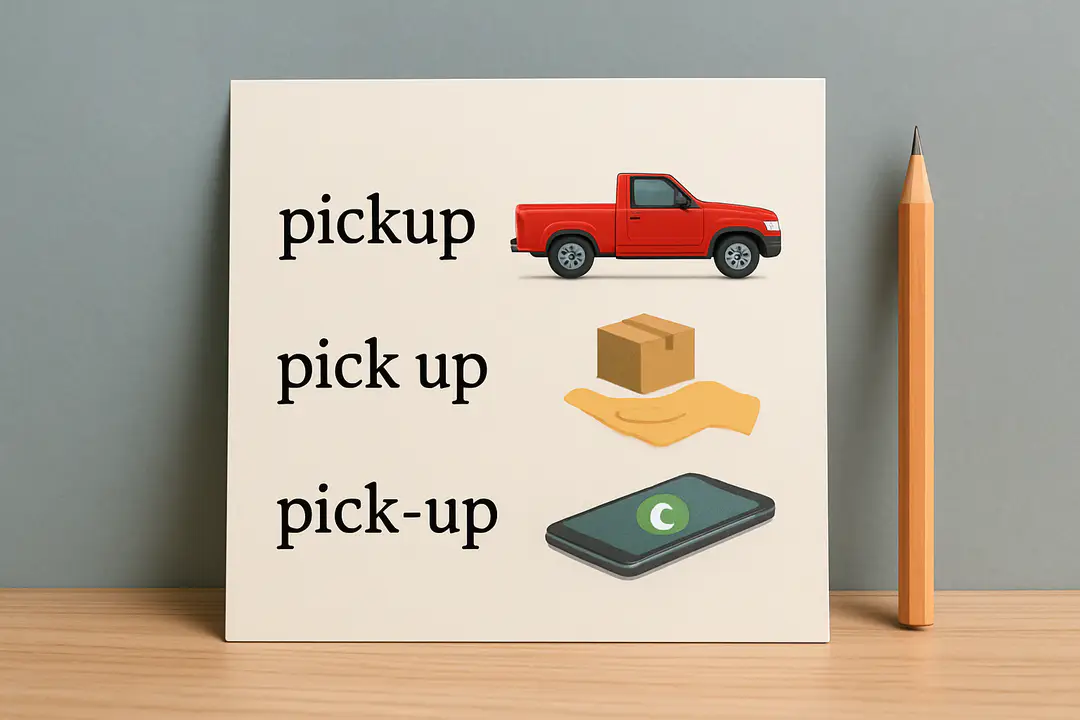

Every day, we toss around phrases like pick up and pickup without a second thought. These small words shape clarity and tone in our writing. Yet, one tiny mark—like a space or a hyphen—can flip meaning entirely. That hyphen often slips under the radar when we write, and it raises more questions than we realize. How do you know which form fits your sentence?
It boils down to recognizing pick up as a verb phrase, pickup as a noun, and pick-up as an adjective. Spotting these differences ahead of time helps you avoid confusion. With a few simple rules, you’ll choose the right form every time. Clear writing builds confidence and prevents misunderstandings. Let’s break it down so you can pick the correct form with ease.
Pick Up as Verb
The phrase pick up is a phrasal verb combining pick and up. It suggests action, like lifting or collecting something. Examples include “I will pick up the mail” and “Can you pick up some coffee?” In each case, you use two separate words.
Place other words correctly. When you pick up an object, you might say “pick it up” or “pick up the report.” Keep pick and up together when acting on a direct object. Otherwise, the reader might stall on interpretation.
Remember, this verb use matches many everyday tasks. You pick up the phone, pick someone up at the airport, or pick up a new skill. You’ll see similar attention to detail in spelling debates. For a deep dive into those, check out spelling debates.
Understanding Pickup Noun
As a noun, pickup names things or events. You might refer to a pickup truck, or say “There was a pickup in sales last quarter.” Here, the single word signals an object or a trend. It carries a concrete meaning.
Use it when you can replace it with “truck” or “increase”. For instance, “He drove his pickup” or “We saw a pickup in service calls.” If that swap works, you know the noun form fits.
In writing, watch for context. If you write about trucks or boosts, go with pickup. This mirrors results in spelling comparisons like usage vs useage. Those correct usage rules help you choose a single word over two.
Pick-Up Adjective Use
When you need an adjective, add a hyphen. The term pick-up describes a noun. For example, “a pick-up game” or “a pick-up point”. This signals that the noun following it is modified by the action of picking up.
Hyphens often tidy up clarity. Without one, readers might misread or pause. Compare “a pick up point” with “a pick-up point.” The hyphen shows combined meaning as an adjective.
Keep modifiers tight. When two words work together to describe a noun, hyphenation helps. Over time, this small link between pick and up ensures your sentence flows smoothly and reads without confusion.
Common Mistakes List
Many writers mix these forms up. Here are frequent errors and quick fixes:
- Writing “pick-up the kids” instead of “pick up the kids.” Fix: Use the verb form without a hyphen.
- Using “pick up truck” as two words. Fix: For the vehicle, write pickup truck.
- Leaving out the hyphen in “pick-up game.” Fix: Add a hyphen when using it as an adjective.
Catch these mistakes by reading aloud. If the phrase sounds like an action, separate the words. If it names an object, stick them together. And if it describes something, link them with a hyphen.
Quick Grammar Tips
Here are practical rules to keep in mind:
- Verb? Break apart. Always pick up for actions.
- Noun? Glue together. Choose pickup for items and events.
- Adjective? Hyphenate. Use pick-up before another noun.
- Test with swap words. If you can swap “truck” or “increase,” you know it’s a noun.
- Read the phrase in full. Natural flow often reveals the right form.
These quick checks simplify choosing the right form without overthinking mid-sentence.
Usage in Context
Seeing each form side by side helps lock in the lesson. Here’s a simple comparison:
| Sentence | Form | Meaning |
|---|---|---|
| I need to pick up my keys. | pick up | verb phrase |
| He drove his old pickup to work. | pickup | noun (vehicle) |
| We arranged a pick-up spot near the gate. | pick-up | adjective (spot) |
| There was a pickup in customer calls. | pickup | noun (increase) |
In professional writing, these small choices build trust. You avoid ambiguity and show respect for the reader. If you ever need to distinguish subtle term differences, similar guidance appears when you compare and contrast terms. That deeper look can save time and confusion.
Conclusion
Choosing between pick up, pickup, and pick-up comes down to function. Use two words for a verb, one word for a noun, and a hyphen for an adjective. Keep these simple rules in mind when drafting emails, reports, or social updates. A quick glance at context and meaning saves edits later. With practice, selecting the right form becomes second nature. Clear writing boosts credibility and keeps your ideas shining. Now you’re ready—pick the right form and watch your message land without a hitch.


