
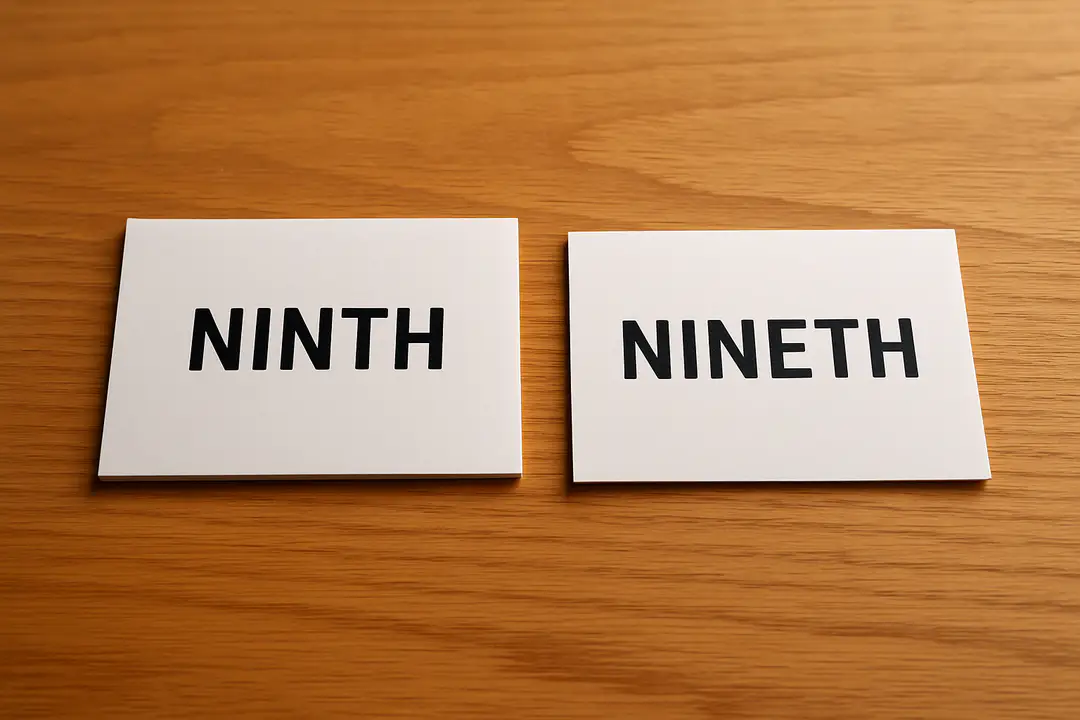

We all know how one small letter can change a word’s meaning. When you write “ninth” instead of “nineth,” it may seem tiny, but it can make your text look careless. Yet many people still mix these two forms. Why does that one extra vowel appear so often?
Understanding why “ninth” is correct and “nineth” is wrong can save you from embarrassing typos. Once you see the simple rule behind it, you’ll spot the error at once. That awareness will boost your confidence when writing essays, emails, or reports.
Origins and Usage
The word “ninth” comes from Old English and traces back to a Germanic root. As English evolved, many ordinal numbers followed a pattern by adding “-th” to the base number. But a spelling shift happened with words ending in “-ne,” like “nine.”
Long ago, scribes dropped the “e” before adding the ordinal suffix. This led to “ninth” instead of “nineth.” Over time, the shorter form became the standard. You will find “ninth” in dictionaries, style guides, and textbooks.
Today, “ninth” appears in calendars, legal texts, and school lessons. In formal writing or when you send a message to a client, this accuracy matters. It shows you care about detail and respect your reader’s time.
Tip: Whenever you see a number ending in “-ne,” remember to remove the “e” before adding “th.” This rule covers “nine,” “one,” and similar endings.
Why the Nineth Error Happens
Even native speakers slip up. Our ears hear the “ne” sound and our fingers type it before we think. We know how “one” becomes “first,” but numbers like “nine” can trick us into keeping the extra vowel.
Another reason is autocorrect. Some word processors may not catch “nineth” if it learns your typing habits. You may type it often enough that the software accepts it as correct.
Finally, confusion with similar words like “tenth” or “sixth” leads to assumptions. You see “tenth” and think every ordinal keeps the base intact. But “nine” is unique in dropping the letter.
Example: “She finished in nineth place” looks wrong at a glance but might slip past a quick read. A careful proofread will catch it every time.
Tip: Read your sentence out loud. Your ear will note that “ninth” sounds smoother than “nineth.”
Spelling Rules for Ordinals
Most ordinals simply add “-th” to the cardinal number. But when the base word ends in “-e,” you drop that letter first. That’s why “nine” loses the “e” before getting the suffix.
| Cardinal | Suffix | Correct Ordinal | Common Error |
|---|---|---|---|
| one | -st | first | onest |
| five | -th | fifth | fiveth |
| nine | -th | ninth | nineth |
This rule holds for any number ending in “-e.” For “one,” you drop the “e” and add “-rst” for “first.” For “five,” you drop the “e” and add “-fth.” Once you know this pattern, you can spell any similar ordinal correctly.
Tips to Remember Spelling
Memorizing a few quick tricks will help you avoid mistakes. Keep these ideas in mind:
- Drop the “e” rule: Remove “e” from any number ending in “-e” before adding the suffix.
- Sound test: Say the word. If it feels clunky with the extra vowel, remove it.
- Flashcards: Write “nine” and “ninth” on cards for a quick review before writing.
- Reference guides: Use tools from our writing tools guide to double-check your text.
- Proofread last: Focus on numbers in a final pass to spot that missing “e” error fast.
Impact on Academic and Business Writing
In school or at work, a small typo can cost you credibility. A misplaced vowel stands out in a well-crafted report. Students lose points on essays if an instructor spots simple misspellings on a numbered list.
When you submit your paper via Blackboard login or on modern classroom platforms, accuracy matters more than ever. It shows respect for the reader and the topic.
In a client email or business proposal, spelling errors can distract from your message. Readers may focus on the mistake rather than your ideas. Avoid this trap by giving ordinals a quick final check.
Practical tip: Keep a list of common ordinal errors by your desk. Refer to it whenever you write or edit. Over time, you’ll type “ninth” automatically without thinking.
Conclusion
Getting “ninth” right instead of “nineth” is a small fix with big benefits. It sharpens your writing, protects your reputation, and removes a common stumbling block. By learning the drop-the-e rule and using simple tools, you can catch this mistake every time.
Next time you list dates, milestones, or ranks, give your ordinals a final read. A quick proofread or an app from our writing tools guide can save you from error. Embrace these tips and watch your confidence grow. Now you’re ready to write with precision and avoid that tricky little vowel once and for all.


