
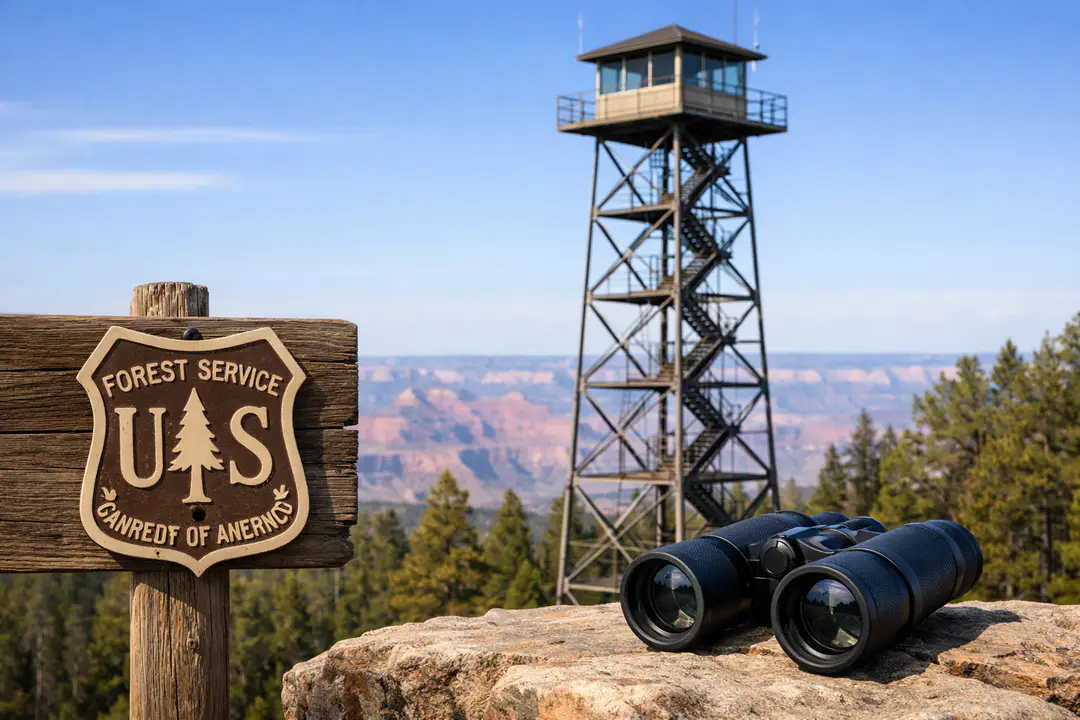

It’s not every day you find an 80 ft historic lookout tower you can still climb—especially one with an original-style 7 ft-square observation cab perched above the ponderosa pine. Add the fact that it also serves as a key Arizona Trail trailhead, and Grandview Lookout Tower becomes more than a quick stop; it’s a practical gateway to big-country views and real Southwest history.
If you’re headed toward the Grand Canyon South Rim and you’re craving a quieter, more hands-on scenic vista than the crowded rim overlooks, this is the kind of detour that pays off. The climb is short but memorable (open-grate steps and all), and the payoff is a 360° view that helps you understand the scale of the Coconino Plateau and the surrounding forest.
This comprehensive guide covers what Grandview Lookout Tower is, why it matters, exact access via Forest Road (FR) 302 / FR 310, what to expect at the site, safety and road conditions, and nearby points of interest—including how to connect with the Arizona Trail (Passage 37). The details here reflect how the U.S. Forest Service manages these sites and what seasoned visitors plan for before heading out.
What Is Grandview Lookout Tower? (Overview)
Grandview Lookout Tower is a historic fire lookout in Kaibab National Forest on the Coconino Plateau of northern Arizona. Built in 1936 by the Civilian Conservation Corps, it’s an 80-foot steel lookout tower designed in the classic Aermotor design used widely across the West. At the top sits a 7 ft-square observation cab (often called the “cab” or “cupola” in casual conversation), where fire staff historically scanned the forest for smoke and lightning starts.
Unlike many retired towers that are closed or only viewable from the ground, Grandview is visitor-accessible in typical conditions. The ascent is via roughly 92 open-grate steps, which is part of the experience: you can see straight down through the grating, and the tower can feel airy and exposed on windy days. From the top, you’re rewarded with a broad view over ponderosa pine forest, distant landmarks like the San Francisco Peaks, and—on clear days—an unmistakable line of the Grand Canyon South Rim.
Its importance is both practical and cultural. Functionally, it represents an era when staffed fire lookouts were a primary detection system across public lands. Historically, it’s a tangible CCC legacy and was added to the National Register of Historic Places in 1988. Recreationally, it’s a quick, high-value stop for photographers, families, and hikers—and it anchors access to the Arizona Trail, making it a meaningful waypoint for day users and long-distance travelers alike.
Quick Facts: Height, History & Coordinates
If you want the essentials before you commit to the drive, this snapshot will help you plan with fewer surprises. Think of it as the “checklist” version of the guide—what it is, why it’s special, and what infrastructure (if any) you should expect.
- Site: Grandview Lookout Tower (historic fire lookout)
- Land manager: U.S. Forest Service (Kaibab National Forest)
- Built: 1936 (Civilian Conservation Corps)
- Structure: 80 ft steel lookout tower
- Design: Aermotor design with a 7 ft-square observation cab
- Climb: Roughly 92 open-grate steps (visitor-accessible when conditions allow)
- Historic designation: Listed on the National Register of Historic Places (1988)
- Setting: Ponderosa pine forest on the Coconino Plateau
- Nearby landmarks: San Francisco Peaks; views toward the Grand Canyon South Rim
- Trail access: Arizona Trail (Passage 37) trailhead/trail junction nearby
- Facilities: Parking pull-out; vault toilet (seasonal); interpretive sign (varies)
Navigation note: Coordinates and road routing can vary slightly across map apps depending on whether they pin the tower itself or the parking pull-out/trailhead. Use a map that labels “Grandview Lookout Tower,” and confirm the approach road as FR 302 / FR 310 before leaving pavement.
Insider tips
- Save an offline map; cell signal can be inconsistent in Kaibab National Forest.
- If anyone in your group is uneasy with heights, set expectations about the open-grate steps before you arrive.
- Morning often brings calmer wind and clearer visibility for long-distance views.
Why Grandview Lookout Tower Is Worth the Detour
Grandview Lookout Tower is worth visiting because it combines three things most forest attractions don’t deliver at once: a climbable historic structure, a true 360° viewpoint, and direct access to a marquee long-distance trail. You can stop for 20 minutes and leave satisfied—or use it as the start of a longer day linking viewpoints and trail miles.
The view is “earned” but approachable
The climb is straightforward (no technical skills), but it feels like an adventure. The open-grate steps and exposed landings make the ascent more visceral than climbing a typical staircase, and that changes how people experience the top. On a clear day, you can orient yourself across the Coconino Plateau and pick out the darker mass of the San Francisco Peaks. With good visibility, you’ll also catch a distant line of the Grand Canyon South Rim—an especially satisfying sight if you’re approaching the canyon for the first time.
It’s a practical stop for Grand Canyon itineraries
For travelers based near Grand Canyon Village or driving Desert View Drive, this tower makes a quiet counterpoint to the busier overlooks. It won’t replace rim time, but it adds perspective—literally—on how forests, plateaus, and canyon country connect. If you’ve ever wondered what the land “behind” the canyon looks like, the tower’s scenic vista answers that question quickly.
Highlights (at a glance)
- Hands-on history: A 1936 CCC-built fire lookout you can still climb.
- Big-sky photography: Excellent horizons at sunrise and late afternoon.
- Trailhead convenience: Arizona Trail access makes it easy to add a hike.
- Less crowding: Often quieter than South Rim viewpoints.
Common mistakes to avoid
- Assuming “it’s just a quick tower”: Wind and weather can change rapidly at elevation.
- Arriving without water: Even short stops can turn into longer visits.
- Skipping a road-conditions check: FR routes can be rutted or muddy after storms.
Quick Facts: Height, History & Coordinates
Grandview is one of those places where the numbers and labels genuinely help you visualize what you’re getting. If you’re planning around kids, a nervous first-time climber, or tight daylight, these specifics matter.
| Feature | What to know |
|---|---|
| Lookout tower height | 80 ft steel tower |
| Construction | Built in 1936 by the Civilian Conservation Corps |
| Design | Aermotor design; 7 ft-square observation cab |
| Stairs | Roughly 92 open-grate steps |
| Historic status | National Register of Historic Places (1988) |
| Trail connection | Arizona Trail (Passage 37) trailhead/trail junction nearby |
Note: Visitors sometimes confuse “Grandview” with Grandview Point along Desert View Drive inside Grand Canyon National Park. Grandview Lookout Tower is in Kaibab National Forest, outside the national park boundary, and the experience is very different (tower climb vs. rim overlook).
History & Significance: From CCC Build to Historic Register
Grandview Lookout Tower’s story is a practical lesson in how the American West was managed before satellites, aircraft patrols, and modern dispatch systems. It’s also a reminder that many “simple” recreation sites exist because earlier generations built durable infrastructure intended for long-term public and agency use.
How fire lookouts fit into forest management
In the early-to-mid 20th century, the U.S. Forest Service relied heavily on a network of staffed fire lookout stations to detect smoke quickly and direct ground crews. Towers were strategically placed for wide visibility and radio communication. On the Kaibab, that meant positioning lookouts where they could scan vast stretches of ponderosa pine—forest types that can carry fast-moving fire under the right wind and fuel conditions.
Grandview’s key milestones
- 1936: Constructed by the Civilian Conservation Corps as an 80 ft steel fire lookout tower.
- Mid-1900s: Operated as part of a broader regional detection network; personnel used the observation cab to spot and report smoke.
- 1988: Added to the National Register of Historic Places, recognizing its historic and architectural significance.
Why the Aermotor design matters
The Aermotor design isn’t just trivia. It’s a standardized engineering approach that allowed towers to be shipped, assembled, and maintained efficiently across remote forests. You’ll notice the utilitarian steel lattice, the compact observation cab, and the functional landings—all designed to balance strength, cost, and visibility. For visitors, that translates to a stable climb, but also an exposed one; you’re moving through a structure that prioritizes function over comfort.
Common visitor misconception
A frequent mistake is assuming that “historic” means “museum-like.” This is still a working landscape. The tower is a preserved structure, but you’re visiting a living national forest with active management, changing road conditions, and seasonal closures that can occur for safety or operations.
Getting There — Exact Directions, Roads & GPS
Reaching Grandview Lookout Tower is usually straightforward if you approach it as a forest-road destination rather than a roadside attraction. The most important planning variables are (1) which direction you’re coming from, (2) current road conditions, and (3) your vehicle’s clearance and tires.
Road access basics (FR 302 / FR 310)
The approach commonly uses Forest Road (FR) 302 / FR 310 in Kaibab National Forest. These are unpaved forest roads that can be smooth when dry and graded, or slow and rutted after storms, snowmelt, or heavy use. If your mapping app tries to route you through lesser spurs, resist the temptation—stick to the signed FR routes whenever possible.
Step-by-step approach (practical method)
- Before you leave pavement: Check the weather (wind, lightning risk, recent precipitation) and consider calling the local U.S. Forest Service office for current road conditions if storms have moved through.
- Set your navigation: Search “Grandview Lookout Tower” and verify the route uses FR 302 / FR 310 rather than unnamed two-tracks.
- Drive slowly on washboards: Washboards can loosen gear and reduce traction. Keep speeds conservative.
- Watch for signed junctions: At each major trail junction or FR intersection, confirm the road number on posted markers—don’t rely solely on a single phone prompt.
- Arrive at the parking pull-out: Park fully off the travel surface to keep the road passable for other vehicles and any service traffic.
Parking and navigation notes
- Parking: Expect a basic parking pull-out rather than a paved lot.
- Turnarounds: Don’t assume a large turnaround for trailers; plan to point your vehicle for an easy departure.
- GPS reliability: Offline maps help; the forest canopy and distance from towers can weaken signal.
Insider tips
- If you’re building a multi-stop day, a little itinerary discipline helps—similar to how you’d plan a careful priority list before a project—because forest-road delays can eat daylight fast.
- After rain or snow, assume muddy patches in shaded spots even if the main road looks dry.
- Carry a full-size spare if possible; sharp cinders and rocks can be hard on tires.
What to Expect at the Tower (Steps, Views, Facilities)
Grandview Lookout Tower is simple on amenities but rich in experience. Most visitors spend 20–60 minutes on site, depending on wind, photography goals, and whether they’re also stepping onto the Arizona Trail.
The climb: open-grate steps and exposure
The tower has roughly 92 open-grate steps leading to the observation cab. That grating is great for shedding rain and snow, but it’s also the #1 surprise for first-time climbers. If you’re sensitive to heights, look straight ahead rather than down through the steps, and take breaks at the landings. The structure can sway slightly in wind; that’s normal for tall steel towers, but it can feel unfamiliar.
- Footwear: Closed-toe shoes with good tread are strongly recommended.
- Kids: Keep children close; the exposure can be distracting and the stairs are steep.
- Groups: Give climbers space; don’t crowd the landings.
The views: orienting the landscape
From the top, you’re looking across the Coconino Plateau’s ponderosa pine, with long sightlines that make landmarks easier to understand. On clear days, the San Francisco Peaks stand out to the south, and you may be able to discern the Grand Canyon South Rim to the north. It’s an excellent place to practice basic terrain reading: note how forest density shifts, how drainages cut subtle lines, and how the horizon changes with weather.
Facilities and on-site features
- Vault toilet (seasonal): Often present but not something to bet your day on—carry toilet paper and sanitizer.
- Interpretive sign: Look for posted history/management information near the base.
- Trailhead/trail junction: Expect nearby access to the Arizona Trail for short hikes or longer segments.
- No water: Plan to be fully self-sufficient.
Common mistakes
- Climbing during lightning: A steel tower is not the place to be in a storm cycle.
- Forgetting wind layers: It can be calm at the car and gusty at the cab.
- Rushing the descent: Many slips happen on the way down—use handrails and take your time.
Safety, Road Conditions & What to Bring
A successful Grandview visit comes down to matching your plan to the day’s conditions. The tower itself is the highlight, but the approach roads and exposure at the top are what most often create avoidable problems.
Road conditions: what changes seasonally
FR routes (including Forest Road (FR) 302 / FR 310) can be affected by snow, spring thaw, and monsoon storms. When the road is wet, even shallow clay sections can become slick. When it’s dry, washboards can reduce vehicle control and increase blowout risk if you’re driving too fast.
- After storms: Expect ruts, puddles, and downed branches.
- During fire restrictions: Some activities may be limited; obey posted orders.
- Winter: Drifts and ice can linger in shaded areas; don’t assume “Arizona” means warm.
On-tower safety: wind, lightning, and comfort
- Wind: If gusts are strong enough to make you brace, consider staying on lower landings.
- Lightning: If you hear thunder, don’t climb. If a storm builds while you’re up top, descend promptly and move away from the tower.
- Vertigo: The open-grate steps can trigger it; one person can wait at the base while others climb.
Packing checklist (day-use)
- 1–2 liters of water per person (more in warm, dry weather)
- Wind layer (light jacket or shell)
- Sun protection: hat, sunglasses, sunscreen
- Snacks (especially if you’ll walk an Arizona Trail segment)
- Offline map or printed directions; car charger
- Basic first-aid kit
Accessibility note
The tower climb is not accessible for all mobility levels due to steep stairs and open-grate steps. However, many visitors still enjoy the site from the base, read the interpretive sign, and take in the forest setting without climbing.
Nearby Points of Interest & Hiking Links (Arizona Trail + More)
Grandview Lookout Tower is a strong anchor for a half-day or full-day loop of viewpoints and hikes. The key is to decide whether you’re doing a “tower-only” stop, pairing it with a short Arizona Trail out-and-back, or building a wider scenic drive that also touches the national park rim.
Arizona Trail (Passage 37): using the trailhead wisely
The Arizona Trail is a long-distance route crossing the state, and the Grandview area ties into Arizona Trail Passage 37. For day users, the best approach is usually a simple out-and-back from the trailhead to a turnaround point you choose by time and weather rather than mileage alone.
- Best for: Stretching legs after the drive; sampling the AZT experience.
- Navigation: Watch for trail junction markers; don’t assume every footpath is the Arizona Trail.
- Timing: Give yourself a “hard turnaround” time so you’re not driving forest roads in darkness.
Grand Canyon South Rim connections
If you’re combining the tower with a South Rim day, plan your route so the tower is either a morning opener (calmer winds, softer light) or a late-afternoon capstone. From there, you can head toward Grand Canyon Village for visitor services and classic rim viewpoints, or drive Desert View Drive for a sequence of overlooks. The contrast is the point: the tower provides a forest-and-plateau context, while the rim provides the dramatic drop into the canyon.
Photography stops and scenic pull-outs
- Forest edges: Where the ponderosa pine thins, you often get cleaner sightlines to distant landmarks.
- Roadside clearings: Use established parking pull-out areas; don’t create new spurs that damage vegetation.
- Golden hour: Late light can add definition to distant terrain and reduce glare.
Insider tips
- If you’re tempted to make it a “tower + rim + multiple stops” day, build in buffer time for road conditions and slower-than-expected hiking.
- Carry extra layers even in shoulder seasons; wind at the observation cab can be sharply colder than the forest floor.
Practical Tips & Best Practices for a Smooth Visit
Grandview Lookout Tower rewards simple, disciplined planning. Most frustration comes from treating it like a paved roadside overlook rather than a backcountry-adjacent historic site with variable access and exposure.
- Time it for weather: If the forecast calls for afternoon thunderstorms, go early. A steel lookout tower is a poor place to gamble with lightning.
- Respect the structure: Climb one step at a time, keep hands on railings, and don’t shake or bounce the tower. This is a historic resource, not playground equipment.
- Plan for wind: Wind is the #1 comfort factor at the top. Bring a shell even if it feels warm at the car.
- Keep your vehicle ready: A basic kit (spare, jack, tire gauge, water) is smart on FR 302 / FR 310. Slow down on washboards to protect tires and suspension.
- Leave no trace at pull-outs: Pack out all trash, avoid widening the parking area, and stay on durable surfaces.
- Be trail-ready if you step onto the AZT: Even a short Arizona Trail out-and-back deserves water, sun protection, and navigation awareness.
- Know when to stop: If someone in your group freezes on the open-grate steps, back down to the last landing calmly. There’s no need to “push through” discomfort at height.
Things to avoid: driving the forest roads too fast, climbing during storm buildup, and assuming the seasonal vault toilet will be stocked or open.
Frequently Asked Questions
Can you climb Grandview Lookout Tower?
In typical conditions, yes—Grandview Lookout Tower is known as a visitor-accessible lookout tower with roughly 92 open-grate steps up to the observation cab. Access can change due to maintenance, storm damage, ice, or safety concerns. If winds are high or storms are near, it’s safer to enjoy the site from the base.
Is Grandview Lookout Tower inside Grand Canyon National Park?
No. The tower is in Kaibab National Forest, managed by the U.S. Forest Service. It’s outside the national park boundary, though you can often see toward the Grand Canyon South Rim from the top. Don’t confuse it with Grandview Point, an overlook along Desert View Drive inside the park.
What makes it historically significant?
It was built in 1936 by the Civilian Conservation Corps as an 80 ft steel fire lookout tower using an Aermotor design, and it was added to the National Register of Historic Places in 1988. It represents the era when staffed fire lookouts were a primary wildfire detection tool across Western forests.
Do I need a high-clearance vehicle to reach it?
Sometimes a standard vehicle can make it in dry, graded conditions, but road conditions on FR 302 / FR 310 can change quickly with rain, snow, or washboarding. High clearance is helpful, and good tires matter more than many people expect. If conditions look poor, don’t force it—turn around before you get stuck.
How long should I plan to spend there?
For a quick visit, 20–40 minutes is common (parking, climbing, photos, reading any interpretive sign). If you add a short Arizona Trail hike from the trailhead or linger for photography and wind breaks, plan 60–120 minutes. Build extra buffer for slow forest-road travel.
Conclusion: Make Grandview Part of Your North Rim-to-South Rim Story
Grandview Lookout Tower is a rare mix of climbable history and practical recreation. You get a real CCC-built 1936 fire lookout, an 80 ft ascent to a compact observation cab, and the kind of 360° visibility that makes the Coconino Plateau feel legible—ponderosa pine stretches, distant peaks, and the subtle line of the Grand Canyon South Rim. Add the Arizona Trail connection and you have a stop that can be as short or as ambitious as your day allows.
The best visits come from respecting what this place is: a historic structure in a working national forest with changing road conditions and real exposure to wind and lightning. Check the forecast, take FR 302 / FR 310 slowly, bring layers and water, and don’t let a tight schedule push you into unsafe choices.
If you’re building a broader northern Arizona itinerary, pair the tower with Desert View Drive or a rim day in Grand Canyon Village, then come back to the forest for the quieter perspective that only a lookout tower can give.
Related planning note: If you’re curating your travel toolkit and comparing options for navigation, photos, and offline access, it’s worth staying aware of broader mobile security considerations when you’re using public Wi-Fi at lodges or visitor hubs.


