
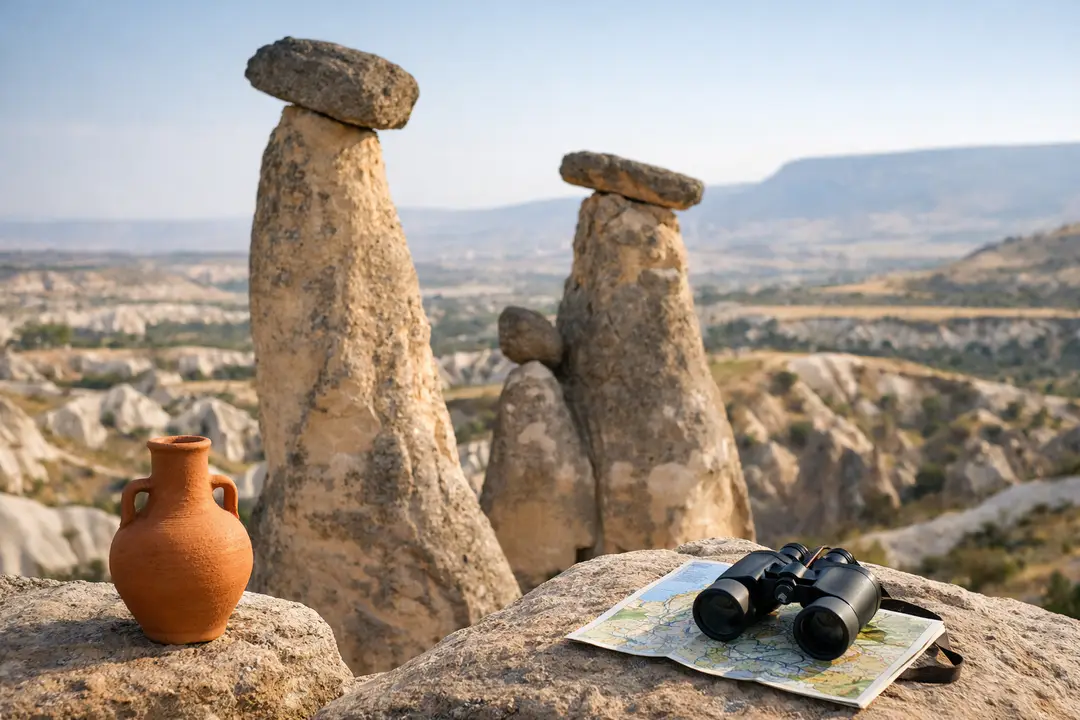

You know the scene: three black-capped rock spires rising from pale tuff, framed by Cappadocia’s rolling valleys and the occasional hot-air balloon drifting in the distance. That postcard view is Three Beauties Valley—Üç Güzeller—and it’s one of the easiest “wow” stops to add to a day around Ürgüp.
But because it’s easy to reach, it’s also easy to do quickly and leave thinking you “saw it,” without catching the best light, the quiet moment between tour buses, or the nearby detours that make the stop feel like a real experience rather than a photo break.
In this guide, I’ll walk you through exactly what Üç Güzeller is, why these fairy chimneys (aka hoodoos) are special, the best seasons and time of day to visit, how to get there via the Ürgüp–Nevşehir highway (including parking), and where to stand for the cleanest sunrise/sunset viewpoints. You’ll also get practical photography advice and a simple 2–4 hour mini-itinerary plus half- and full-day options that pair well with Pasabag, Pigeon Valley, and Devrent Valley.
What Is Three Beauties Valley (Üç Güzeller)? / Overview
Three Beauties Valley, known locally as Üç Güzeller, is a roadside viewpoint featuring a famous trio of fairy chimneys near Ürgüp in Cappadocia, Turkey. The “three beauties” are distinctive because of their proportions and their darker stone “caps,” which make them instantly recognizable in photos compared to many other formations in the region.
In Cappadocia, fairy chimneys are tall rock columns formed when softer volcanic ash (tuff) erodes away around harder layers. You’ll also hear the term hoodoos, a more general geological word for similar spires found in places like the American Southwest. At Üç Güzeller, the capstone layer helps protect the pillar beneath it, slowing erosion and creating that classic mushroom-like silhouette.
Why does this spot matter? For many travelers, it’s the first (or most accessible) close-up look at Cappadocia’s geology without committing to a long hike. It’s also a practical junction point: from here you can quickly connect to other must-sees around Ürgüp, Göreme, Avanos, and the open-air valleys.
Most visits are short, but with a little planning—timing for the right light, choosing your angle, and pairing it with nearby valleys—you can turn a quick stop into one of your most satisfying photo-and-landscape sessions in Cappadocia.
Where is Three Beauties Valley (Üç Güzeller)? Quick facts & map
Üç Güzeller sits just outside Ürgüp, right off the main road connecting Ürgüp and Nevşehir. It’s the kind of place you can fit in even on a transfer day—provided you understand the layout (viewpoint vs. roadside pull-offs) and arrive at a calmer time.
At a glance
- Location: Near Ürgüp, in Cappadocia, Turkey
- Nearest town: Ürgüp (a few minutes by car)
- Access road: Along the Ürgüp–Nevşehir highway (easy roadside stop)
- What you’re seeing: Three black-capped fairy chimneys / hoodoos
- Recommended visit length: 20–40 minutes for a quick stop; 1–2 hours if you want multiple angles and calmer light
- Best for: Easy views, iconic photos, pairing with nearby valleys
How to orient yourself on arrival: Most people approach from Ürgüp and pull into a parking area or roadside shoulder. The classic composition is visible almost immediately, but the best photos usually come from walking a few minutes to adjust your angle and reduce distractions (cars, signage, souvenir stands).
- Tip: If you’re driving, save the location offline before you leave your hotel—cell coverage is generally fine around towns, but it’s still worth downloading a Cappadocia map.
- Common mistake: Photographing from the first available pull-off at midday. The rocks can look flat in harsh sun, and the foreground gets busy fast.
If you’re building a broader plan for the region, it helps to review a few simple comfort-focused travel habits before you lock in back-to-back driving days—Cappadocia rewards early starts and good pacing.
Why visit the Three Beauties — what makes these fairy chimneys special
Üç Güzeller isn’t the biggest valley in Cappadocia, and it’s not a long hike. The reason to visit is simpler: it’s an iconic geological “portrait” you can view up close, quickly, and in changing light—especially if you time it well.
What stands out about Üç Güzeller
- The black caps: The darker capstone layer creates strong contrast in photos, especially in soft morning or late-afternoon light.
- The trio composition: Three formations grouped together is visually clean and memorable—great for wide shots and tighter framing.
- Easy access: You don’t need a long walk or special gear; it’s one of the most convenient fairy chimney viewpoints near Ürgüp.
- It pairs well: It’s a natural “first stop” before heading deeper to places like Pasabag or Devrent Valley.
How to make the stop feel richer (not rushed)
- Give yourself 30 minutes minimum to step away from the curb and find a calmer angle.
- Look for layers: Include vineyards, low stone walls, or rolling tuff hills in the foreground to show scale.
- Watch the sky: Thin clouds at sunset can add texture; a clear blue sky can feel harsh at noon.
A quick “real-world” example
If you arrive at 11:30 a.m. in July, you’ll likely get strong overhead light, bright highlights, and deep shadows under the caps—fine for a quick record shot. Arrive around 7:00–8:00 a.m. (or 30–45 minutes before sunset) and the same scene becomes warmer, softer, and more three-dimensional.
Common mistake: Treating Üç Güzeller as “the” fairy chimney stop and skipping other formations. Consider it your iconic viewpoint—then use nearby valleys for variety.
Best time to visit (seasons, weather, crowds)
Timing is everything at Three Beauties Valley. The formations are always there, but the experience changes dramatically with temperature, crowd levels, and the angle of the light.
Season-by-season guide
- Spring (March–May) — best overall: Cooler days, greener edges in the landscape, and wildflowers that soften the foreground. Crowds are often lighter than peak summer, and you can comfortably combine Üç Güzeller with short walks elsewhere.
- Summer (June–August) — peak season: Long days and lots of tours. Midday heat can be intense, so plan to visit early morning or in the last 60–90 minutes before sunset. Bring water even for short stops.
- Autumn (September–November) — excellent balance: Pleasant temperatures, good visibility, and generally fewer crowds than summer. The landscape shifts to warmer, drier tones that can look fantastic at golden hour.
- Winter (December–February) — quiet and dramatic: Fewer visitors and moody skies. Occasional snow can turn the viewpoint into a high-contrast scene, but roads can be icy and windchill can be biting.
Best time of day
- Sunrise to mid-morning: Softer shadows, fewer cars in the background, and a calmer feel overall.
- Sunset: Warm color on the rock and a higher chance of photogenic skies.
- Midday: Most crowded, harshest light—best only if it’s your only window.
Small planning table: choose your “best” visit
| Time | Pros | Cons |
|---|---|---|
| Early morning | Best light, fewer crowds, cooler temps | Requires early start |
| Late afternoon / sunset | Golden tones, great atmosphere | Can be busy in peak season |
| Midday | Convenient for quick stop | Harsh light, heat in summer, more traffic |
Common mistake: Scheduling Üç Güzeller between two indoor activities at midday. Flip it: do museums/caves at noon, save viewpoints for early/late light.
How to get there: driving, parking, public transport & tours
Three Beauties Valley is one of the simplest stops in Cappadocia logistically. The main decisions are whether to drive yourself, hire a taxi for a short loop, or join a day tour that includes multiple valleys.
Driving (most flexible)
- Start in Ürgüp and follow the road toward Nevşehir (the Ürgüp–Nevşehir highway).
- Look for the Üç Güzeller viewpoint area—you’ll often spot the formations before you see signage.
- Use designated parking when available. In busy periods, you may see cars on the shoulder—be cautious and avoid blocking traffic.
- Walk a few minutes after parking to find a cleaner composition away from the busiest curbside spots.
- Parking tips: Arrive early in summer; keep valuables out of sight; expect small vendors near the viewpoint.
- Time estimate: From central Ürgüp, the drive is just a few minutes.
Taxi (easy for non-drivers)
- Ask your hotel to arrange a taxi for a short “Ürgüp viewpoint loop.”
- Agree on waiting time (30–60 minutes) and whether you’re adding nearby stops.
Public transport
- Public transport isn’t the most convenient for this specific viewpoint. If you’re relying on buses, pair the stop with other destinations and expect some walking.
Tours (good if you want context)
- Many Cappadocia tours include short viewpoint stops. Confirm in advance whether Üç Güzeller is included and how long you’ll have there.
Common mistake: Budgeting only 10 minutes because it’s “right by the road.” Between parking, walking a bit, and waiting for a gap in crowds, 30 minutes is a safer minimum.
Photography tips & best viewpoints (sunrise/sunset)
Üç Güzeller is famously photogenic, but it’s also easy to end up with distracting elements: parked cars, harsh shadows, and busy foregrounds. A few small choices make a big difference.
Best light and angles
- Go for golden hour: Early morning and sunset add depth to the rock texture and reduce “flat” contrast.
- Shift your position: Walk a few minutes left/right from the main cluster to reduce the amount of road and signage in frame.
- Try a layered composition: Place low shrubs, stone walls, or rolling tuff ridges in the foreground for scale.
- Include people sparingly: One person near the base can show height, but a big group can clutter the scene.
Simple camera/phone settings that help
- On a phone: Tap to expose for the rock (not the sky), then slightly lower exposure to keep capstone detail.
- On a camera: A mid-range zoom (around 35–70mm full-frame equivalent) often gives the cleanest look by compressing background clutter.
- HDR: Useful in midday when the caps throw deep shadows, but avoid overdoing it—rock texture can look crunchy.
Do / Don’t checklist
- Do: Bring a lens cloth—Cappadocia dust and wind are real.
- Do: Shoot a wide frame, then a tight frame—your favorite might be the tighter one.
- Don’t: Stand in the road for a “clean shot.” Traffic can move fast and unpredictably.
- Don’t: Ignore the background; a small step can remove power lines or parked vehicles.
Mini case study: If you arrive at sunset and the main pull-off is crowded, don’t fight for the exact center spot. Move 20–30 meters and use a tighter crop. You’ll often get a cleaner frame and a calmer experience.
What to see nearby: Pasabag, Pigeon Valley, Devrent Valley
Üç Güzeller is strongest when you treat it as part of a short route—especially if you’re already based in Ürgüp or Göreme. Within an easy drive, you can compare different fairy chimney shapes and landscape “moods” in a single day.
Top nearby stops (with why they’re worth it)
- Pasabag (Monks Valley): One of the best places to see multi-headed fairy chimneys up close. The forms here feel more clustered and sculptural than Üç Güzeller, and you can walk among them.
- Pigeon Valley: Known for panoramic viewpoints and historic pigeon houses carved into the cliffs. It’s a great option if you want a gentle hike and wider landscape photos rather than a quick roadside stop.
- Devrent Valley (Imagination Valley): Famous for rock shapes that resemble animals and profiles. It’s less about hiking and more about short walks and playful photography angles.
How to pair them efficiently
- If you want a half-day: Üç Güzeller + Pasabag is a strong combo (iconic trio + up-close formations).
- If you want more walking: Add Pigeon Valley for a viewpoint-to-viewpoint hike.
- If you’re traveling with kids (or curious friends): Devrent Valley adds an easy, interactive stop.
Common planning mistake
Trying to “collect” every valley in one afternoon and arriving at each one in harsh midday light. Instead, pick two main stops and one optional stop, and schedule the most photogenic viewpoint (often Üç Güzeller) for early or late light.
Legend & geology: the story behind the Three Beauties
A big part of Cappadocia’s appeal is how the landscape invites both science and storytelling. Üç Güzeller comes with both: a local legend often framed around a family or the “three graces,” and a very real geological process that explains the black caps and tall pillars.
The local legend / “three graces” in brief
Versions vary, but the popular local legend ties the trio to a human story—often a mother, father, and child—turned to stone after a forbidden love, a disapproving ruler, or divine intervention. Another telling links the three formations to the idea of “three graces” (three beauties), a symbolic trio representing charm and grace. However you hear it, the point is consistent: three figures bound together, recognizable even from a distance.
The geology (why the caps matter)
Cappadocia’s fairy chimneys formed from layers of volcanic material laid down over time. Wind and water eroded the softer tuff faster than the harder rock above it. Where a harder “cap” remained, it shielded the pillar beneath—creating the classic hoodoo profile. Over long timescales, caps can crack or fall, and new shapes emerge, which is why different valleys have different silhouettes.
- What to look for on-site: Color changes between layers, rough texture on the capstone, and the way the pillar narrows toward the top.
- Common mistake: Climbing or leaning on fragile rock surfaces. Erosion is natural, but human pressure speeds up damage.
Suggested 2–4 hour visit and half-/full-day itineraries
If you’re staying in Ürgüp or nearby, it’s easy to treat Üç Güzeller as a quick photo stop. With a little structure, you can also turn it into a relaxed mini-outing—especially if you’re chasing the best sunrise/sunset viewpoints.
2–4 hour mini-visit (focused on Üç Güzeller)
- Arrive (0:00–0:15): Park, take a moment to scan where crowds are clustering, and decide whether to start with wide or tight shots.
- Main viewpoint photos (0:15–0:45): Get your classic frame, then walk a few minutes for cleaner angles.
- Light and detail session (0:45–1:30): Shoot capstone textures, experiment with portrait framing, and include a person for scale.
- Optional short detour (1:30–3:30): Add a nearby café in Ürgüp, or a quick second viewpoint stop if you’re building a loop.
Half-day idea (best for first-timers)
- Early morning: Üç Güzeller (soft light)
- Mid-morning: Pasabag (walk among formations)
- End: Back to Ürgüp for lunch and a slower afternoon
Full-day idea (variety + pacing)
- Morning: Üç Güzeller + Pasabag
- Midday (harsh light window): Lunch + an indoor/covered stop (museum, cave church, or a long break)
- Afternoon: Devrent Valley (short walks, playful shapes)
- Sunset window: Pigeon Valley viewpoint(s) or return to Üç Güzeller if you missed the best light
Planning tip: Keep a little buffer for parking and short walks. If you like structure, use a quick checklist approach similar to prioritizing what matters first—choose your top two stops, then add extras only if time and energy allow.
Practical tips / Best practices (accessibility, facilities, safety and bookings)
Üç Güzeller is straightforward, but a few practical details can make the stop smoother—especially in summer heat or winter wind.
- Accessibility: The viewpoint is near the road, which helps if you have limited mobility. Surfaces can be uneven and dusty once you step away from the curb, so wear stable shoes.
- Facilities: Expect basic vendor setups near the viewpoint in busy seasons. For reliable restrooms and meals, plan to use Ürgüp.
- Safety near the road: Stay aware of traffic, especially if you’re photographing from a roadside pull-off. Keep kids close and avoid backing into the road while framing a shot.
- Weather: Wind is common in Cappadocia. Bring a light layer even in warmer months; in winter, gloves help for sunrise/sunset sessions.
- What to pack (even for a short stop):
- Water (especially in summer (June–August))
- Sunscreen and sunglasses
- A lens cloth / phone wipe for dust
- A light jacket for spring (March–May) mornings and autumn (September–November) evenings
- Respect the site: Don’t climb the formations. The rock can be fragile, and small damage adds up quickly.
Things to avoid: Arriving with zero time buffer (you’ll feel rushed), assuming midday light will look “like the postcards,” and leaving valuables visible in your car during busy periods.
FAQ
How long do you need at Three Beauties Valley (Üç Güzeller)?
Most people spend 20–40 minutes for photos. If you want better angles, fewer distractions, and time to wait out crowds, plan 60–90 minutes. Photographers often prefer a full golden-hour window (up to 2 hours) to capture changing light on the caps and pillars.
Is Üç Güzeller worth it if I’m already visiting other fairy chimneys?
Yes—because it’s a distinct “icon” composition and very close to Ürgüp. Think of it as a quick, high-impact viewpoint rather than a hiking destination. Pair it with Pasabag for close-up walking among formations, and you’ll get both the postcard shot and the immersive experience.
What’s the best season for visiting Üç Güzeller?
Spring (March–May) is the best all-around pick: comfortable temperatures, wildflowers, and generally lighter crowds than summer. Autumn (September–November) is a close second with excellent weather and warm landscape tones. Summer is doable with early/late timing; winter is quieter but colder and sometimes icy.
Can you visit Üç Güzeller by public transport?
It’s possible but not the easiest option because the viewpoint is designed for roadside access. If you’re not driving, a taxi from Ürgüp is the simplest solution. Many regional day tours also include short stops at viewpoints like this, but confirm the exact itinerary and how much time you’ll have on site.
Are sunrise/sunset viewpoints better than midday?
For most travelers and almost all photographers, yes. Sunrise and sunset bring softer shadows and warmer tones that show the rock texture, while midday light can flatten the formations and emphasize harsh contrast under the capstones. If midday is your only option, use tighter framing to reduce distractions and consider HDR on a phone.
Conclusion
Three Beauties Valley (Üç Güzeller) is one of Cappadocia’s easiest iconic stops: three black-capped fairy chimneys—classic hoodoos—standing just outside Ürgüp. The key to enjoying it isn’t complicated: arrive in better light (early morning or sunset), give yourself enough time to walk a few minutes away from the curb, and frame thoughtfully to avoid road clutter.
For the best overall experience, aim for spring (March–May) if you can, or autumn (September–November) for that comfortable, uncrowded balance. Then build out your day with nearby contrasts—walk among formations in Pasabag, chase panoramas in Pigeon Valley, and finish with the playful shapes of Devrent Valley.
Next step: pick your time window (sunrise or sunset), choose whether you’re driving or taking a taxi/tour, and slot Üç Güzeller into a half-day loop that matches your pace. With a little timing and intention, this quick roadside viewpoint becomes one of your strongest memories—and photos—of Cappadocia.


